
A decent weather window has opened up for our 650-nm passage from Utila to the Dry Tortugas, which should take about seven days. Winds are expected to blow mostly from the northeast, so we’re anticipating an uncomfortable close reach for most of the journey.
Für unsere 650 Seemeilen lange Überfahrt von Utila zu den Dry Tortugas, die etwa sieben Tage dauern dürfte, hat sich ein günstiges Wetterfenster aufgetan. Wind wird voraussichtlich überwiegend aus Nordosten wehen, sodass wir für den größten Teil der Reise ziemlich am Wind segeln werden, leider nicht gerade angenehm.
It is very hard to leave this time because we are not only leaving the Caribbean, at least for the time being, but we also have to say goodbye to some of our good friends, Renate and Peter, and Ute and Hajot. We have spent so many wonderful hours together, enjoyed going on trips, and best of all, had someone to turn to if problems occurred that we wanted to discuss with somebody.
Es fällt uns sehr schwer, diesmal abzureisen, denn wir verlassen nicht nur die Karibik, zumindest vorläufig, sondern müssen uns auch von einigen unserer guten Freunde verabschieden, Renate und Peter sowie Ute und Hajot. Wir haben so viele schöne Stunden miteinander verbracht, Ausflüge unternommen und vor allem hatten wir jemanden, an den wir uns wenden konnten, wenn Probleme auftraten, die wir mit jemandem diskutieren wollten.


This has been part of our lives since we decided to live on the boat—you have to leave good friends behind. Fortunately, we have managed to stay in touch with most of them, and we hope to see them again in the future.
Das gehört zu unserem Leben, seit wir uns entschieden haben, auf dem Boot zu leben – man lässt gute Freunde zurück. Glücklicherweise ist es uns gelungen, mit den meisten in Kontakt zu bleiben, und wir hoffen, sie in Zukunft wiederzusehen zu können.
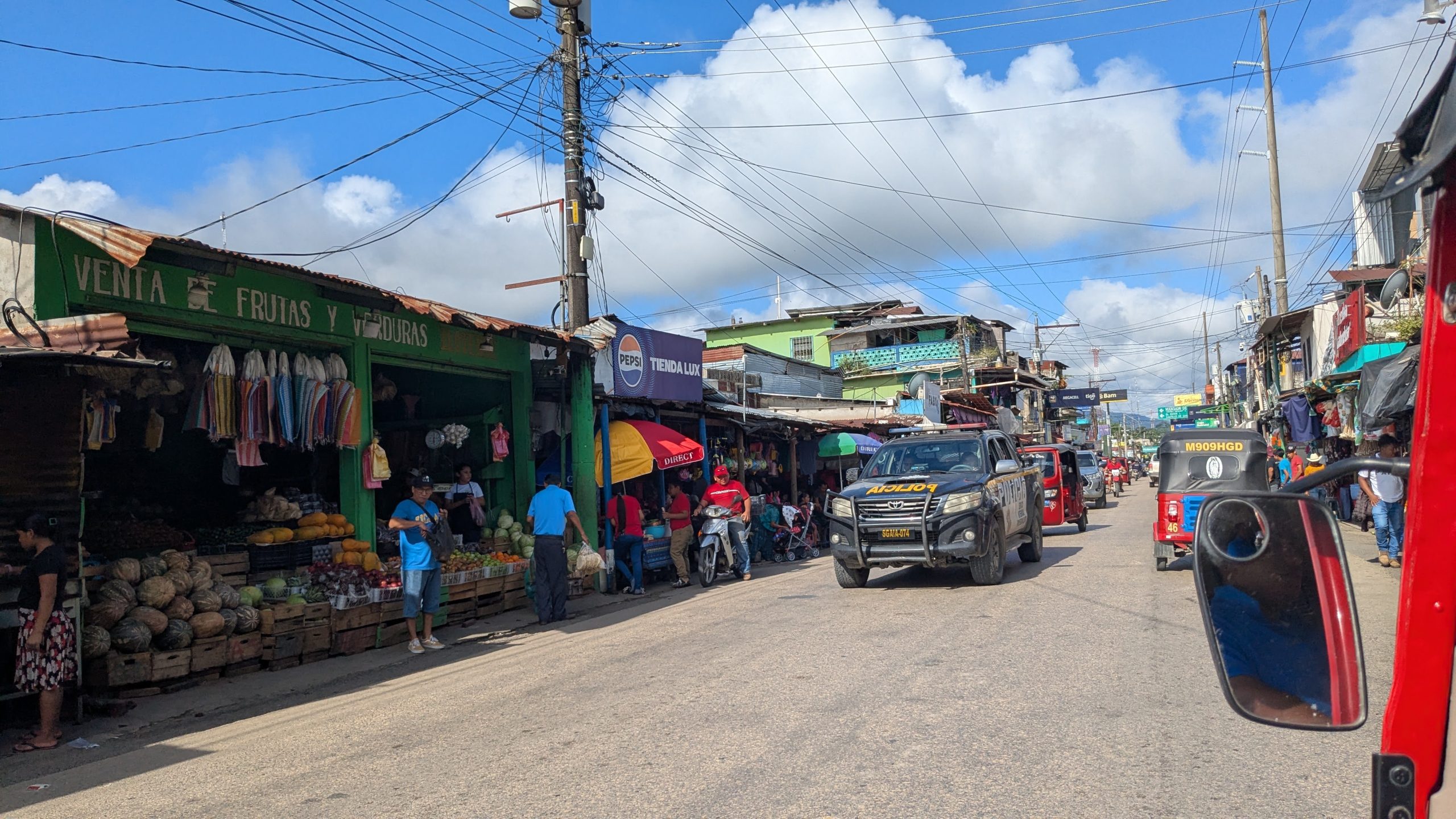
The day before we left, we stop by the immigration office, squeeze in a dental appointment for Hans, and spend our remaining Honduran lempiras at a fruit and vegetable stand.
Am Tag vor unserer Abreise statten wir der Einwanderungsbehörde einen Besuch ab, schaffen es noch, einen Zahnarzttermin für Hans zu vereinbaren, und geben unsere restlichen honduranischen Lempiras an einem Obst- und Gemüsestand aus.


On December 17, 2025, we leave Utila at 7:30 a.m., an hour later than planned. This is the result of the potent drinks that Hajot and Ute served us the night before, when we stopped by to say goodbye.
Am 17. Dezember 2025 verlassen wir Utila um 7:30 Uhr, eine Stunde später als geplant. Das liegt an den starken Drinks, die Hajot und Ute uns am Abend zuvor serviert haben, als wir vorbeikamen, um uns zu verabschieden.
That day, winds blow from the southwest to the west at speeds between 6 and 9 knots. At times, this isn’t enough to fill our genoa, which consequently flogs around. We spend our time furling it in, turning the engine on, and letting the sail out again, only to turn the engine off when the wind picks up a little. While we’re not in a hurry, moving at a speed of about 1 knot with 2- to 3-foot swells doesn’t make for a comfortable ride.
An diesem Tag weht der Wind aus Südwest bis West mit einer Geschwindigkeit von nur 6 bis 9 Knoten. Manchmal reicht das nicht aus, um unsere Genua zu füllen, die dann entsprechend herumflattert. Wir verbringen unsere Zeit damit, sie einzurollen, den Motor anzuschalten und das Segel wieder auszusetzen, nur um den Motor wieder abzuschalten, wenn der Wind etwas auffrischt. Wir haben es zwar nicht eilig, aber bei einer Geschwindigkeit von etwa 1 Knoten und Wellen bis zu einem Meter schaukelt es uns doch ziemlich herum, nicht gerade angenehm.
As expected, the wind shifts to the east-northeast at around 10 pm. There is some rain and a swell of up to six feet.
Wie erwartet dreht der Wind gegen 22 Uhr auf Ost-Nordost. Es gibt etwas Regen und einen Swell bis zu zwei Meter.
Over the next two days, the wind continues to blow from the northeast to the east-northeast at 8 to 15 knots, and we happily chug along at 4 to 5 knots. We finally seem to have figured out how to use our monitor wind steering system. We shortened one side of the steering linkage, and voilà—the system works great! In the past, we just assumed that both sides needed to be the same length. We could have solved the issue a long time ago.
In den nächsten zwei Tagen weht der Wind weiterhin mit 8 bis 15 Knoten aus Nordost bis Ost-Nordost, und wir tuckern fröhlich mit 4 bis 5 Knoten dahin. Endlich scheinen wir herausgefunden zu haben, wie wir unser Monitor-Windsteuersystem richtig einsetzen. Wir haben eine Seite der Lenkverbindung gekürzt, und voilà – das System funktioniert hervorragend! Bisher gingen wir einfach davon aus, dass beide Seiten genau gleich lang sein müssen. Wir hätten das Problem schon vor langer Zeit lösen können.

On December 20, 280 nautical miles into our trip, the wind picks up to 25 knots and the wave intervals decrease. To reduce heeling and make it easier to move around on the boat, we decide to put two reefs in the mainsail and partially furl the genoa.
Am 20. Dezember, nach 280 Seemeilen, nimmt der Wind auf 25 Knoten zu und die Wellenabstände werden kürzer. Um die Schräglage zu verringern und die Beweglichkeit auf dem Boot zu verbessern, beschließen wir, zwei Reffs im Großsegel zu setzen und die Genua teilweise einzurollen.
The forecast now predicts stronger winds and waves up to 9 ft from the east over the next few days, with gusts to the mid-thirties. These winds will blow through the Straits of Florida, which connect the Gulf of Mexico and the Atlantic Ocean. Given the west-to-east-running Gulf Stream current added to the mix, we don’t want to be exposed to these conditions. Therefore, we decide to seek shelter in an anchorage on the northeast coast of Cuba. On the 21st, we sail all day in winds over 20 knots with two reefs in the mainsail and just a little genoa out. We continuously make between six and seven knots. At 10:30 p.m., we drop anchor in Los Cayos, a very remote but open bay that allows us to approach safely despite the pitch-black night.
Die Vorhersage sagt nun für die nächsten Tage zunehmenden Wind und Wellen von bis zu 9 Fuß aus östlicher Richtung voraus, mit Böen bis zu 35 Knoten. Diese Winde werden durch die Straits of Florida wehen, die den Golf von Mexiko und den Atlantischen Ozean verbindet. Angesichts der zusätzlich west-östlich verlaufenden Golfströmung möchten wir uns diesen Bedingungen nicht unbedingt aussetzen. Deshalb beschließen wir, in einem Ankerplatz an der Nordostküste Kubas Schutz zu suchen. Am 21. segeln wir den ganzen Tag bei Windgeschwindigkeiten von über 20 Knoten mit zwei Reffs im Großsegel und nur einem kleinen Genua. Wir erreichen kontinuierlich eine Geschwindigkeit zwischen sechs und sieben Knoten. Um 22:30 Uhr gehen wir in Los Cayos vor Anker, einer sehr abgelegenen, aber offenen Bucht, die es uns ermöglicht, trotz der stockdunklen Nacht sicher anzukommen.
We spend one day in Los Cayos weighing our options, when a fishing boat approaches us. Fifteen minutes later, we have ten beautiful lobsters! We cook eight of them, cut them into bite-sized pieces, and freeze them. We grill the remaining two and enjoy them with garlic butter and a fresh-baked baguette.
Wir verbringen einen Tag in Los Cayos, um unsere nächsten Schritte zu überlegen, als ein Fischerboot auf uns zukommt. Fünfzehn Minuten später haben wir zehn wunderschöne Hummer! Wir kochen acht davon, schneiden sie in mundgerechte Stücke und frieren sie ein. Die restlichen zwei grillen wir und genießen sie mit Knoblauchbutter und frisch gebackenem Baguette.


The next morning, December 23rd, we get ready to leave again. Our plan is to motor east along the coast, where we assume the water will be calmer and the winds won’t be as strong as they are out on the open water. Once the winds subside in two days, we will head to the Dry Tortugas.
Am nächsten Morgen, dem 23. Dezember, machen wir uns bereit, wieder aufzubrechen. Unser Plan ist es, entlang der Küste nach Osten zu fahren, wo wir davon ausgehen, dass das Wasser ruhiger und der Wind nicht so stark ist wie auf offener See. Sobald der Wind in zwei Tagen nachlässt, werden wir uns auf den Weg zu den Dry Tortugas machen.
Forty-five minutes into motoring into the wind and waves, smoke fills the engine room. Not again! We’ve been dealing with engine issues since Colombia, where we hired a mechanic to help us. We had been losing coolant, but we could not figure out where it was going. The mechanic fixed the exhaust connection, and we changed the air filter, hoping that would solve the problem. However, we continued to have intermittent issues all the way to Mexico and then Guatemala. Thinking the smoke might be caused by leaking exhaust seals, we asked a fellow sailor at the RAM Marina in Rio Dulce to bring back a new set of seals from the U.S. After replacing the seals and air filters, we revved the engine up to 2,800 RPMs, and everything seemed to work as expected. Until now, that is.
Nach 45 Minuten Fahrt gegen Wind und Wellen füllt sich der Maschinenraum mit Rauch. Nicht schon wieder! Seit Kolumbien haben wir mit Motorproblemen zu kämpfen und haben dort einen Mechaniker engagiert, der uns helfen sollte. Wir hatten Kühlflüssigkeit verloren, konnten aber nicht herausfinden, wo sie hinging. Der Mechaniker reparierte die Auspuffverbindung, und wir wechselten den Luftfilter in der Hoffnung, dass das Problem damit gelöst wäre. Allerdings hatten wir bis nach Mexiko und dann Guatemala weiterhin zeitweise Probleme. Da wir vermuteten, dass der Rauch durch undichte Auspuffdichtungen verursacht wurde, baten wir einen anderen Segler in der RAM Marina in Rio Dulce, uns einen neuen Satz Dichtungen aus den USA mitzubringen. Nachdem wir die Dichtungen und Luftfilter ausgetauscht hatten, drehten wir den Motor auf 2.800 Umdrehungen pro Minute hoch, und alles schien wie erwartet zu funktionieren. Bis jetzt jedenfalls.
We turn around and go back to Los Cayos. After the engine cools down, we check the air filters, which are clogged again. For now, there isn’t much more we can do besides replace the filters and add coolant.
Wir kehren um und fahren zurück nach Los Cayos. Nachdem der Motor abgekühlt ist, überprüfen wir die Luftfilter, die wieder verstopft sind. Im Moment können wir nicht viel mehr tun, als die Filter auszutauschen und Kühlmittel nachzufüllen.

Contrary to the forecast, the wind dies down to seven knots by 6 p.m., so we decide to take advantage of the calmer conditions. We hoist the anchor and continue on to our next anchorage overnight. At first, everything goes well: light wind, calm water, and good progress. But soon enough, things go downhill again, and we are bashing into increasing winds and waves. During the night, we hardly make any headway—only 20 nautical miles in 14 hours! Occasionally, the speedometer shows less than one knot. So much for our assumption that conditions would be calmer close to shore. We go a little further out, hoist the main with two reefs in, unfurl the genoa, and tack our way into Cayo Buenavista. It’s a spirited sail with strong winds the whole time, gusts up to 34 knots, and waves crashing over the bow and hitting us in the cockpit. We are glad we are not further out in the Straits of Florida. At one point, we switch from the autopilot to hand-steering so we can get closer to the wind. Sailing like this is actually really fun, but we’re still glad to arrive in Cayo Buenavista at 6 p.m. on December 24.
Entgegen der Vorhersage lässt der Wind gegen 18 Uhr auf sieben Knoten nach, sodass wir beschließen, die ruhigeren Bedingungen zu nutzen. Wir lichten den Anker und setzen unsere Fahrt zum nächsten Ankerplatz über Nacht fort. Zunächst läuft alles gut: leichter Wind, ruhiges Wasser und guter Fortschritt. Aber schon bald geht es wieder bergab und wir kämpfen mit zunehmendem Wind und Wellen. In der Nacht kommen wir kaum voran – nur 20 Seemeilen in 14 Stunden! Gelegentlich zeigt der Tacho weniger als einen Knoten an. So viel zu unserer Annahme, dass die Bedingungen in Küstennähe ruhiger sein würden. Wir fahren etwas weiter hinaus, hissen das Großsegel mit zwei Reffs, setzen die Genua und kreuzen nach Cayo Buenavista. Es ist eine temperamentvolle Fahrt mit starken Winden, Böen bis zu 34 Knoten und Wellen, die über den Bug schlagen und in das Cockpit spritzen. Wir fragen uns, wie es wohl weiter draußen in der Straße von Florida gewesen wäre. Wir wechseln vom Autopiloten zum Handsteuern, um näher am Wind segeln zu können. Es macht eigentlich richtig Spaß, mal wieder so zu segeln, aber wir sind trotzdem froh, als wir am 24. Dezember um 18 Uhr in Cayo Buenavista ankommen.
We spend Christmas Day still trying to figure out the engine issue. Members of the “Westerbeke Owners” Facebook group offer suggestions, which we try one by one. We also learn that there is a good diesel mechanic in Titusville, Florida, where we have already planned to spend a couple of weeks anyway. Hopefully, he will be able to fix the issue once and for all. In the meantime, we will have to make do, which is no problem as long as we don’t exceed 1,500 RPMs for an extended period of time.
Wir verbringen den Weihnachtstag damit, das Problem mit dem Motor zu lösen. Mitglieder der Facebook-Gruppe „Westerbeke Owners“ geben uns Tipps, die wir nacheinander ausprobieren. Wir erfahren auch, dass es in Titusville, Florida, einen guten Dieselmechaniker gibt. Das passt perfekt, da wir ohnehin schon geplant hatten, ein paar Wochen dort zu verbringen. Hoffentlich kann er das Problem ein für alle Mal beheben. In der Zwischenzeit müssen wir uns behelfen, was kein Problem ist, solange wir 1.500 Umdrehungen pro Minute nicht überschreiten.

On December 26 at 7 a.m., we leave Cayo Buenavista. Our decision to wait for better sailing conditions pays off. We have winds ranging from 15 to 20 knots from the north to northeast. The windvane is engaged, and we enjoy an absolutely beautiful sail under blue skies for the next two days. We tack back and forth, making 3.5 to 4.5 knots. The speed increases to 5.5 knots once we enter the Gulf Stream current. Along the way, we each land a mahi-mahi. We use some of the fish for ceviche, leave one fillet out to put on the grill once we will be in the Dry Tortugas, and put the rest in the freezer.
Am 26. Dezember um 7 Uhr morgens verlassen wir Cayo Buenavista. Unsere Entscheidung, auf bessere Segelbedingungen zu warten, zahlt sich aus. Wir haben Winde von 15 bis 20 Knoten aus Nord bis Nordost. Die Windfahne ist aktiviert, und wir genießen die nächsten zwei Tage ein absolut wunderschönes Segeln unter blauem Himmel. Wir kreuzen hin und her und erreichen Geschwindigkeiten von 3,5 bis 4,5 Knoten. Sobald wir in die Golfströmung kommen, steigt die Geschwindigkeit auf 5,5 Knoten. Unterwegs fangen wir jeweils einen Mahi-Mahi. Einen Teil des Fangs verwenden wir für Ceviche, ein Filet legen wir beiseite, um es in Dry Tortugas zu grillen, und den Rest legen wir in den Gefrierschrank.

We motor the last few miles so that we won’t have to enter the Garden Key anchorage at night, and we enjoy a beautiful view of Loggerhead Key with its lighthouse and Fort Jefferson on Garden Key.
Wir legen die letzten paar Meilen mit dem Motor zurück, damit wir nicht nachts in den Ankerplatz von Garden Key einlaufen müssen, und genießen die wunderschöne Aussicht auf Loggerhead Key mit seinem Leuchtturm und Fort Jefferson auf Garden Key.
At 6 p.m. on December 27, we finally drop anchor in the Dry Tortugas after 11 days and 777 nautical miles. Our top speed was 8.5 knots, average 4.4 knots. We log into CBP Roam to check in, and an hour later, we received our clearance number. After three years, we are back in the United States!
Am 27. Dezember um 18 Uhr werfen wir nach 11 Tagen und 777 Seemeilen endlich den Anker in den Dry Tortugas. Unsere Höchstgeschwindigkeit betrug 8,5 Knoten, die Durchschnittsgeschwindigkeit 4,4 Knoten. Wir melden uns bei CBP Roam zum Einchecken an und erhalten eine Stunde später unsere Freigabenummer. Nach drei Jahren sind wir wieder in den Vereinigten Staaten!
We wake up to a calm and glorious first day in the Dry Tortugas. After sleeping in and enjoying a nice breakfast, we clean the salt-encrusted boat. We watch the ferry from Key West arrive and seaplanes land and take off again.
Wir wachen zu einem ruhigen und herrlichen ersten Tag in den Dry Tortugas auf. Nachdem wir ausgeschlafen und ein leckeres Frühstück genossen haben, reinigen wir das mit Salzkrusten bedeckte Boot. Wir beobachten, wie die Fähre aus Key West ankommt und Wasserflugzeuge landen und wieder starten.

After launching the dinghy, we go ashore and explore Fort Jefferson, whose construction started in 1846 and continued for 30 years, though it was never finished. The goal was to control navigation to the Gulf of Mexico and protect Atlantic-bound Mississippi River trade by fortifying the Dry Tortugas, a cluster of seven islands located approximately 70 miles west of Key West, Florida.
Nachdem wir das Beiboot zu Wasser gelassen haben, gehen wir an Land und erkunden Fort Jefferson, dessen Bau 1846 begann und 30 Jahre lang andauerte, obwohl es nie fertiggestellt wurde. Das Ziel war es, die Schifffahrt zum Golf von Mexiko zu kontrollieren und den Handel auf dem Mississippi in Richtung Atlantik zu schützen, indem die Dry Tortugas, eine Gruppe von sieben Inseln etwa 70 Meilen westlich von Key West, Florida, gesichert wurden.

During the Civil War, the fort served as a Union military prison, but it was abandoned for military use in 1874.
Während des Bürgerkriegs diente das Fort als Militärgefängnis der Union, wurde jedoch 1874 für militärische Zwecke aufgegeben.

Strolling through the fort, which was built with 16 million bricks, was really interesting.
Der Gang durch die Festung, die aus 16 Millionen Ziegeln erbaut wurde, war wirklich interessant.


In the late afternoon, we grill the mahi filet that we hadn’t put in the freezer, and then we go ashore again for an evening stroll. Absolutely gorgeous!
Am späten Nachmittag grillen wir das Mahi-Filet, das wir nicht in den Gefrierschrank gelegt hatten, und gehen dann wieder an Land, um einen Abendspaziergang zu machen. Wunderschön!


Day two starts with us dragging anchor. Great. During the night, the wind shifted and strengthened to 20 knots. In anticipation of the front coming though we had checked the anchor the previous evening, and it was deeply dug into coarse sand. We don’t know why we dragged, but regardless, we have to hoist the anchor and look for another spot.
Der zweite Tag beginnt damit, dass wir abtreiben. Na toll. In der Nacht hat sich der Wind gedreht und auf 20 Knoten verstärkt. In Erwartung der Front hatten wir am Vorabend den Anker überprüft, und er steckte tief im groben Sand. Wir wissen nicht, warum wir abgetrieben sind, aber egal, wir müssen den Anker lichten und uns einen anderen Platz suchen.
Later in the day, we hop in the dinghy and take a walk along the beach, watching pelicans dive for fish and frigate birds soar in the sky. It’s very windy out, and we’re glad we brought a jacket.
Später am Tag steigen wir in das Beiboot und machen einen Spaziergang am Strand entlang, wo wir Pelikane beim Fischfang beobachten und Fregattvögel am Himmel kreisen sehen. Es ist sehr windig draußen, und wir sind froh, dass wir eine Jacke mitgebracht haben.


What a difference a day makes!
Was ein Unterschied zu gestern!
Schreibe einen Kommentar