
Before heading to a part of Nova Scotia we had wanted to visit four years ago, we stopped for a few days in Canso, a place we fondly remembered from our first visit. The main reason for another stop was to get our yearly blood work done. While it would have taken three weeks to schedule an appointment in Halifax, we were able to easily make one in Canso. Since we know what a lovely town Canso is, we didn’t mind stopping there.
Bevor wir uns auf den Weg in einen Teil von Nova Scotia machten, den wir schon vor vier Jahren besuchen wollten, machten wir für ein paar Tage Halt in Canso. Wir erinnerten uns gerne an unseren ersten Besuch dort. Der Hauptgrund für diesen erneuten Zwischenstopp war, dass wir unsere jährlichen Blutuntersuchungen durchführen lassen wollten. Während wir in Halifax drei Wochen auf einen Termin hätten warten müssen, konnten wir in Canso problemlos einen Termin bekommen. Da wir wissen, was für ein reizender Ort Canso ist, machte es uns nichts aus, dort Halt zu machen.


We got a visit from the Canadian border police, who were patrolling the area. Very friendly guys.
Wir bekamen Besuch von der kanadischen Grenzpolizei, die in der Gegend patrouillierte. Äusserst freundlich und zuvorkommend.


We’re always looking for ways to stretch our legs, so we hiked the beautiful Chapel Gulch Trail. It’s like walking into a magical forest, complete with little fairy gardens. The people of Canso clearly take pride in and care for this trail.
Wir sind ja immer auf der Suche nach Möglichkeiten, uns die Beine zu vertreten. So sind wir den wunderschönen Chapel Gulch Trail gewandert. Es ist, als würde man einen zauberhaften Wald mit kleinen Feengärten betreten. Die Einwohner von Canso sind sichtlich stolz auf diesen Wanderweg und kümmern sich liebevoll darum.


One evening, we took the Waterfront Trail to the fishing harbor to see if we could buy lobster from one of the ships that had just come in. Unfortunately, we were a few minutes late, and the fishermen had already weighed their catch. Noticing our disappointment, the captain instructed a woman to remove two lobsters from the bin, weigh them, and deduct their weight from his next catch. He looked for a bag, stuffed the lobsters in, and handed us the bag with a big smile, telling us to enjoy our dinner. Once again, this was a prime example of Canadian friendliness!
An einem Abend spazierten wir den Waterfront Trail entlang zum Fischereihafen, in der Hoffnung, Hummer von einem der gerade eingelaufenen Schiffe kaufen zu können. Leider kamen wir ein paar Minuten zu spät und die Fischer hatten ihren Fang bereits gewogen. Als der Kapitän unsere Enttäuschung bemerkte, wies er eine Frau an, zwei Hummer aus dem Behälter zu nehmen, sie zu wiegen und ihr Gewicht von seinem nächsten Fang abzuziehen. Er suchte nach einer Tüte, stopfte die Hummer hinein und reichte sie uns mit einem breiten Lächeln. Dabei wünschte er uns, noch guten Appetit. Wieder einmal ein Paradebeispiel kanadischer Freundlichkeit!


Almost four years ago, when we came through this area, Lake Bras d’Or in the center of Cape Breton Island in Nova Scotia was high on our list of places to visit. Unfortunately, we were short on time back then, so we were looking forward to visiting this time. Lake Bras d’Or is connected to the open sea and experiences tides. Freshwater inflows from rivers make the brackish water a very productive natural habitat. Designated a UNESCO Biosphere Region, the lake is celebrated for its deep, fjord-like channels; sheltered coves; and rich biodiversity, including Atlantic salmon and American eels.
Als wir vor fast vier Jahren durch diese Gegend kamen, stand der Bras-d’Or-See im Zentrum von Cape Breton Island in Nova Scotia ganz oben auf unserer Liste der Orte, die wir besuchen wollten. Leider hatten wir damals zu wenig Zeit, weshalb wir uns dieses Mal umso mehr darauf freuten. Der Bras d’Or-See ist mit dem offenen Meer verbunden und unterliegt den Gezeiten. Durch den Zufluss von Süßwasser aus Flüssen ist das Brackwasser ein sehr produktiver natürlicher Lebensraum. Der als Biosphärenreservat ausgewiesene See ist bekannt für seine tiefen, fjordartigen Kanäle, geschützten Buchten und seine reiche Artenvielfalt, zu der unter anderem Atlantischer Lachs und Amerikanische Aale gehören.

We entered through the 800-meter St. Peter’s Canal, one of the few tidal locks in North America.
Wir fuhren durch den 800 Meter langen St.-Peter-Kanal, eine der wenigen Gezeitenschleusen Nordamerikas.


The Mi’kmaq, an Indigenous people of the First Nations, lived here long before the Gaels immigrated from Scotland. Thousands of Gaels settled in eastern Nova Scotia between the mid-1700s and the early 1900s. Their story, culture, and identity are beautifully recreated in the Bailenan Gaidheal Highland Village, an outdoor museum. It was a lovely walk from the dinghy dock to the museum, mostly along an abandoned railway track with a great view of the lake.
Die Mi’kmaq, ein Volk der First Nations, lebten hier schon lange, bevor die Gälischen aus Schottland einwanderten. Zwischen Mitte des 18. und Anfang des 20. Jahrhunderts ließen sich Tausende von ihnen im Osten von Nova Scotia nieder. Ihre Geschichte, Kultur und Identität werden im Freilichtmuseum „Bailenan Gaidheal Highland Village“ auf wunderschöne Weise dargestellt. Der Spaziergang vom Dinghydock zum Museum war echt schön und führte größtenteils entlang einer stillgelegten Bahnstrecke, von der aus sich ein herrlicher Blick auf den See bot.


We walk a scenic 2.4 km walking trail on Goat Islan showcasing the Mi’kmaq culture.
Wir wandern auf Goat Island auf einem 2,4 km langen, landschaftlich reizvollen Wanderweg, der uns die Kultur der Mi’kmaq näherbringt.


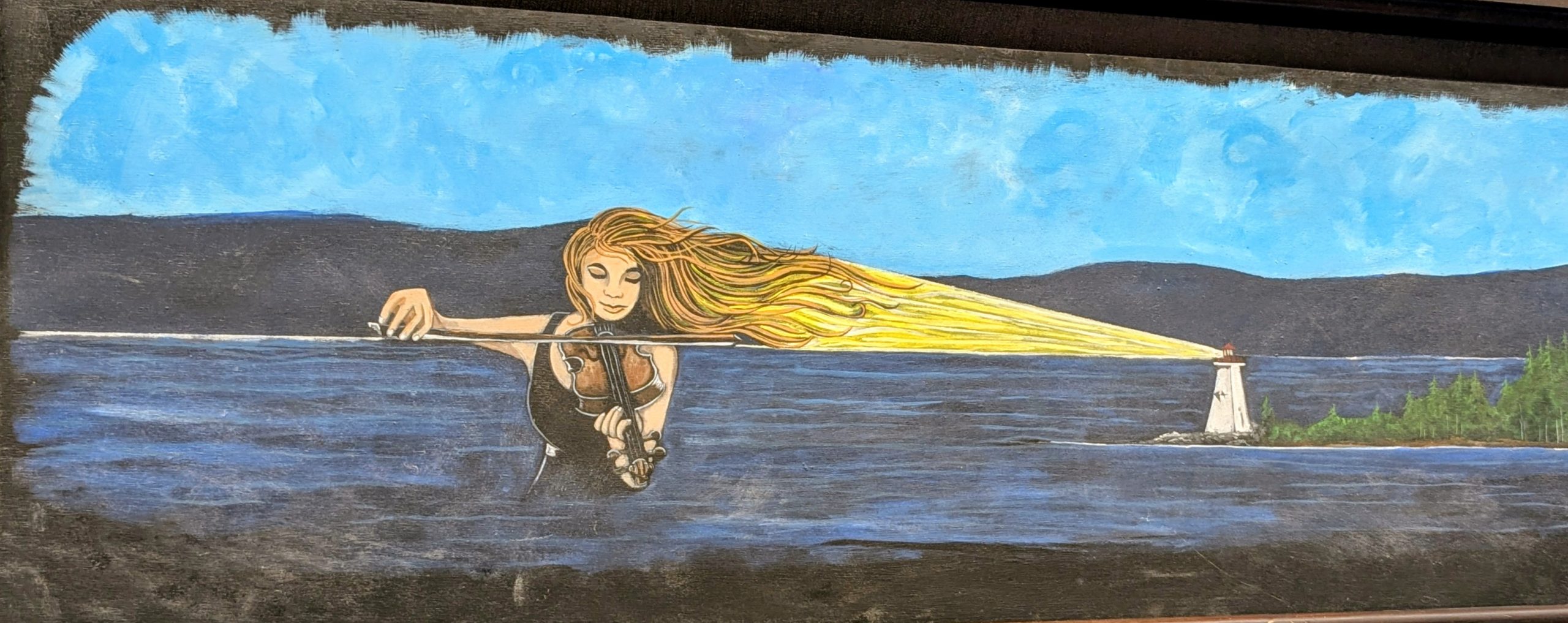
One tradition that has endured over time is the ceilidh, a social gathering rooted in Scottish and Irish Gaelic culture. During these gatherings, people would visit their neighbors, chat, and make music. Today, the cèilidh has evolved into an evening of lively entertainment featuring live music with instruments like the fiddle, guitar, bagpipes, and piano. Sometimes there is dancing, storytelling, and singing, as well as refreshments like tea and oatcakes (buttery oat cookies).
Eine Tradition, die sich bis heute erhalten hat, ist das Ceilidh, ein geselliges Beisammensein, das in der schottischen und irisch-gälischen Kultur verwurzelt ist. Bei diesen Zusammenkünften besuchten die Menschen ihre Nachbarn, unterhielten sich und machten gemeinsam Musik. Heute hat sich der Ceilidh zu einem Abend mit lebhafter Unterhaltung entwickelt, bei dem Live-Musik mit Instrumenten wie Geige, Gitarre, Dudelsack und Klavier im Mittelpunkt steht. Manchmal wird auch getanzt, es werden Geschichten erzählt und gesungen und es gibt Erfrischungen wie Tee und Oatcakes (butterige Haferkekse).

We were lucky to get tickets to one of the events in Baddeck. Too bad we can’t add videos to the blog, or we could give you an acoustic taste of a ceilidh. The musicians invited the audience to participate by joining in the easy choruses and tapping their feet or clapping to the rhythm. During intermission, tea was served in beautiful mugs from a real teapot. (Here is a Youtube link to a similar event https://www.youtube.com/shorts/y0dzl-dV40Y)
Wir hatten das Glück, Karten für eine der Veranstaltungen in Baddeck zu bekommen. Schade, dass wir keine Videos in den Blog einbinden können, denn sonst könnten wir euch einen akustischen Eindruck von einem Ceilidh vermitteln. Die Musiker luden das Publikum ein, mitzumachen, indem sie die einfachen Refrains mitsangen und im Takt mit den Füßen wippten oder klatschten. In der Pause wurde Tee in schönen Tassen aus einer echten Teekanne serviert. (Hier ist ein Link zu einer ähnlichen Veranstaltung https://www.youtube.com/shorts/y0dzl-dV40Y)


Baddeck is also home to the Alexander Graham Bell National Historic Site. Like most people, we only knew that Bell invented the telephone. We were therefore fascinated to learn about his other inventions, including a metal detector, a tetrahedral kite, and the hydrofoil boat, the latter of which particularly piqued our interest. Bell created the HD-4 hydroplane, which set a world marine speed record in 1919. He was truly ahead of his time.
In Baddeck befindet sich auch die “Alexander Graham Bell National Historic Site”. Bell ist ja hauptsächlich für die Erfindung des Telefons bekannt. Umso faszinierter waren wir, als wir von seinen anderen Erfindungen erfuhren, darunter ein Metalldetektor, ein tetraedrischer Drachen und das Hydrofoil-Boot, das unser besonderes Interesse weckte. Bell entwickelte das Tragflügelboot HD-4, das 1919 einen Geschwindigkeitsweltrekord auf See aufstellte. Er war seiner Zeit wirklich weit voraus.


If you’re planning to leave Lake Bras d’Or heading north, timing is everything because of the strong current between Carey Point and Noir Point. The best time to pass through is three hours after high tide in Sydney. With a four-knot current in our favor, we timed it perfectly.
Wenn man vom Bras d’Or-See aus in Richtung Norden fahren möchten, ist es aufgrund der starken Strömung zwischen Carey Point und Noir Point wichtig, den richtigen Zeitpunkt zu wählen. Der beste Moment für die Durchfahrt ist drei Stunden nach Hochwasser in Sydney. Mit einer Strömung von vier Knoten in unserem Rücken haben wir den Zeitpunkt perfekt getroffen.

We spent about a week on this beautiful lake which is surrounded by rolling hills and dotted with islands, sometimes glittering in the sunshine, other times obscured by fog. No matter the weather, this lake has offered interesting culture, quaintvillages and beautiful scenery. But then it was time to move on. Next stop – Newfoundland!
Wir verbrachten etwa eine Woche an diesem wunderschönen See, der von sanften Hügeln umgeben ist und von zahlreichen Inseln übersät wird. Mal glitzert er in der Sonne, mal liegt Nebel auf dem See. Unabhängig vom Wetter bot er interessante kulturelle Eindrücke, malerische Dörfer und wunderschöne Landschaften. Doch dann war es Zeit, weiterzuziehen. Nächstes Ziel – Neufundland!
Schreibe einen Kommentar