
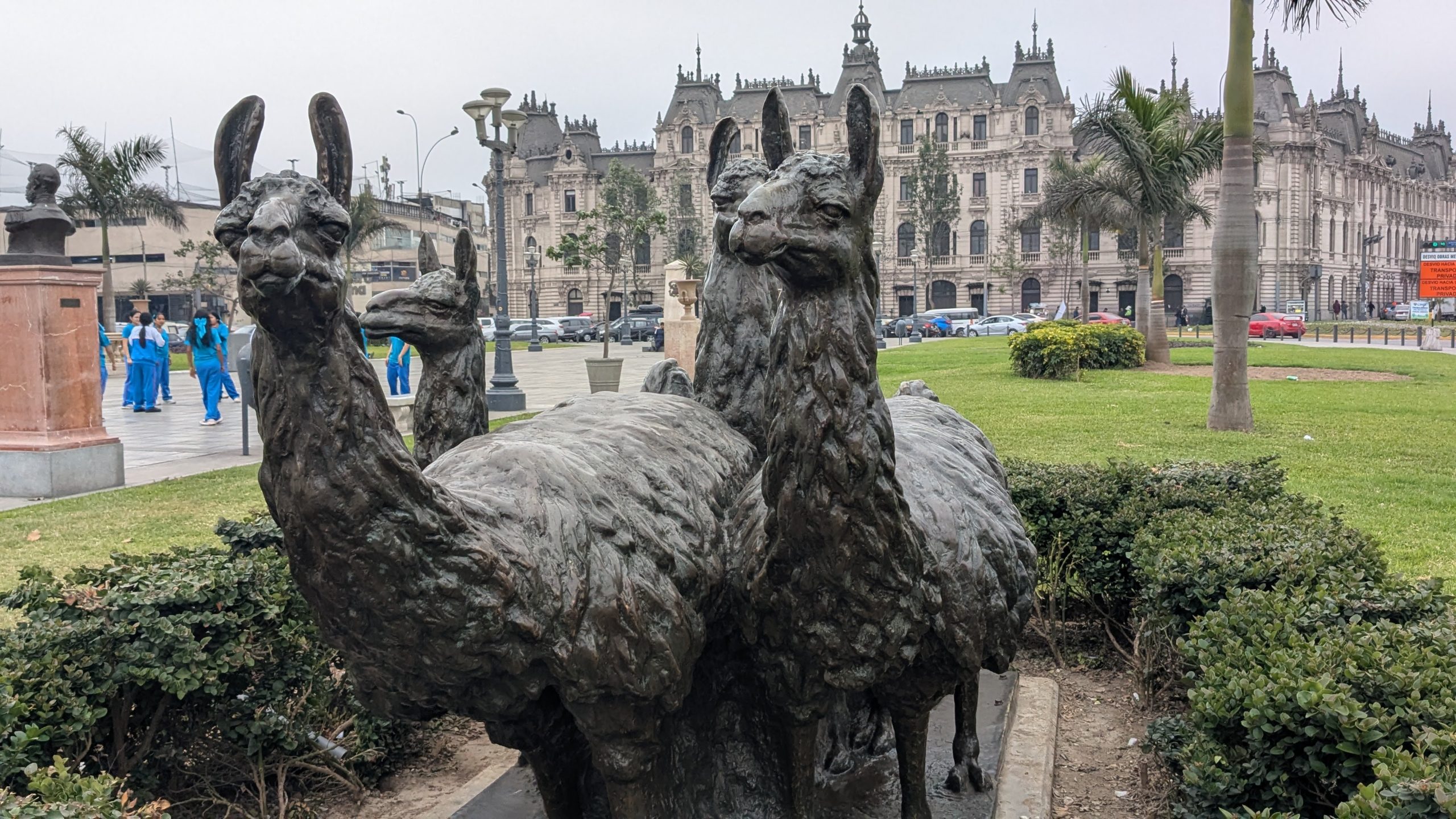
We’ve got two days in Lima, and we’re going to spend the first one checking out all the landmarks in the downtown area. To get to the Centro Historico, we take Bus Line C from Estacion Ricardo Palma to Jiron de la Union.
Wir haben zwei Tage in Lima und werden den ersten Tag nutzen, um uns alle Sehenswürdigkeiten in der Innenstadt anzuschauen. Um zum Centro Historico zu gelangen, nehmen wir die Buslinie C von der Estacion Ricardo Palma zum Jiron de la Union.


First, we walk to Plaza Mayor de Lima, also called Plaza de Armas, as so many other plazas in Peru are called. Pizarro, a Spanish conquistador who led the conquest of the Inca Empire, set up this 140-square-meter square as the center of the continent. The Spanish executed their opponents in the square, and in 1821, they declared independence from Spain right there. The square is surrounded by impressive architecture. The east side of the square is home to the Catedral de Lima, which was founded by Pizarro in 1535. It’s been rebuilt many times since then, and it’s got twin towers and the Archbishop’s Palace of Lima (Palacio Arzobispal de Lima) connected to it.
Zuerst gehen wir zur Plaza Mayor de Lima, auch Plaza de Armas genannt, wie so viele andere Plätze in Peru. Pizarro, ein spanischer Konquistador, hat die Eroberung des Inka-Reiches angeführt und diesen 140 Quadratmeter großen Platz als Zentrum des Kontinents eingerichtet. Die Spanier haben ihre Gegner auf dem Platz hingerichtet und Peru hat 1821 genau dort die Unabhängigkeit von Spanien erklärt. Der Platz ist von beeindruckender Architektur umgeben. Auf der Ostseite des Platzes steht die Catedral de Lima, die 1535 von Pizarro gegründet wurde. Seitdem wurde sie mehrfach umgebaut und hat zwei Türme und den Erzbischofspalast von Lima (Palacio Arzobispal de Lima), der mit ihr verbunden ist.


Then, we’ll head to Desamparados Station, a gorgeous old train station that’s now abandoned. It was built in 1912 and was the centerpiece of the continent’s first railway line. Now it’s home to the Casa de Literature Peruana, with a little library and art gallery.
Danach geht’s zum Bahnhof Desamparados, einem wunderschönen alten Bahnhof, der heute verlassen ist. Er wurde 1912 gebaut und war das Herzstück der ersten Eisenbahnlinie des Kontinents. Heute ist in dem Gebäude die Casa de Literature Peruana mit einer kleinen Bibliothek und einer Kunstgalerie untergebracht.


Parque La Muralla is located behind the station. This park has views of a vibrant neighborhood built on a hill across the river.
Der Parque La Muralla ist gleich hinter dem Bahnhof. Von diesem Park aus hat man einen tollen Blick auf ein farbenfrohes Viertel, das auf einem Hügel gegenüber dem Fluss gebaut wurde.

Now it’s time for lunch with a nice view of the Gran Bolivar Hotel on Plaza San Martin. Back in the 1940s and 1950s, this spot was a favorite of Hollywood movie stars like Orson Welles, Ava Gardner, and John Wayne.
Zeit für ein Mittagessen mit schöner Aussicht auf das Gran Bolivar Hotel an der Plaza San Martin. In den 1940er und 1950er Jahren war dieser Ort ein beliebter Treffpunkt von Hollywood-Stars wie Orson Welles, Ava Gardner und John Wayne.


We spend the afternoon walking from Parque San Martín to the Park of the Exhibition, enjoying all the beautiful colonial buildings on the way.
Wir spazieren vom Parque San Martín zum Park der Ausstellung und genießen dabei die schönen Kolonialgebäude entlang des Weges.


The Parque de la Exposición has a bunch of buildings that were built for the 1872 International Exhibition in Lima. Some of the highlights include the Byzantine Pavilion, Moorish Pavilion, Fuente China (Chinese Fountain), and Japanese Garden. Today, the Parque de la Exposición is a popular urban recreational and cultural space in Peru’s busy capital. It’s home to two major museums: the Museo de Arte de Lima (MALI) (in the converted Palacio de la Exposición) and the Museo Metropolitano de Lima. The park seems to be the go-to place for local couples to snuggle, and the fence around most of the park means that it’s a quiet oasis free of crowds.
Then, we’ll walk a bit more south to the last stop in the area, which is the Magic Water Circuit (Circuito Mágico del Agua) in another big park. This is thought to be the biggest collection of water fountains on the planet. It’s too bad we’re there during the day because the real magic happens at night.
We take the express bus back from Estacion Nacional to Ricardo Palma, and it is just a five-minute walk to our hotel. On the way, we cross Parque Kennedy, where there was a big flower exposition that week.
Der Parque de la Exposición besteht aus einer Reihe von Gebäuden, die für die Internationale Ausstellung 1872 in Lima gebaut wurden. Besonders sehenswert sind der byzantinische Pavillon, der maurische Pavillon, ein chinesischer Brunnen und der japanische Garten. Heute ist der Parque de la Exposición ein beliebter städtischer Erholungs- und Kulturraum in der geschäftigen Hauptstadt Perus. Es gibt zwei große Museen: das Museo de Arte de Lima (MALI) im umgebauten Palacio de la Exposición und das Museo Metropolitano de Lima. Dank der Umzäunung des größten Teils des Parks ist er eine ruhige Oase ohne Menschenmassen.
Dann gehen wir noch ein Stückchen weiter zur letzten Attraktion in dieser Gegend, dem Magic Water Circuit (Circuito Mágico del Agua). Das ist die größte Sammlung von Springbrunnen auf der Welt. Schade, dass wir tagsüber dort sind, denn die wahre Pracht entfaltet sich erst nachts.
Wir nehmen den Expressbus von der Estacion Nacional zurück nach Ricardo Palma, von wo aus es nur noch fünf Minuten zu Fuß zu unserem Hotel sind. Auf dem Weg kommen wir am Parque Kennedy vorbei, wo diese Woche eine große Blumenausstellung stattfand.


We wrap things up with a taste of the famous picarones from Picarones Mary, which was featured on the Netflix documentary Street Food: Latin America. Picarones are a traditional Peruvian dessert, similar to a doughnut, made from a dough of pumpkin, sweet potato, and wheat flour, which is then fried into a ring shape and served hot with a sweet syrup made from chancaca (unrefined cane sugar). Yum!
Zum Abschluss probieren wir die berühmten Picarones von Picarones Mary, die in der Netflix-Dokumentation „Street Food: Latin America“ vorgestellt wurden. Picarones sind ein traditionelles peruanisches Dessert, ähnlich wie Donuts, das aus einem Teig aus Kürbis, Süßkartoffeln und Weizenmehl hergestellt wird, der dann in Ringform frittiert und heiß mit einem süßen Sirup aus Chancaca (unraffiniertem Rohrzucker) serviert wird. Lecker!


Schreibe einen Kommentar