
When the wasps start building a nest, it’s definitely time to move on. After switching our 130% genoa for a 90% jib in anticipation of stronger winds the farther north we go, we did exactly that. On May 2, we left Titusville and took the Intracoastal Waterway to Smyrna to test the engine a little more. Everything worked well!
Wenn mal die Wespen anfangen, ein Nest zu bauen, ist es definitiv Zeit, weiterzufahren. Nachdem wir unsere 130-Prozent-Genua gegen eine 90-Prozent-Fock ausgetauscht hatten – in Erwartung stärkerer Winde, je weiter wir nach Norden kamen –, taten wir genau das. Am 2. Mai verließen wir Titusville und fuhren über den Intracoastal Waterway nach Smyrna, um den Motor noch ein wenig zu testen. Alles funktionierte einwandfrei!


Feeling confident about our new engine, we went through the Ponce de Leon Inlet the next morning. We hoped that we wouldn’t end up like this poor fellow.
Da wir von unserem neuen Motor voll überzeugt waren, fuhren wir am nächsten Morgen durch den Ponce-de-Leon Zugang zum Meer. Wir hofften, dass uns nicht dasselbe Schicksal ereilen würde wie diesen armen Kerl.

Winds of 12 to 20 knots and waves of 2 to 3 feet are ideal conditions for our first day on the ocean since mid-January. As usual, we have the fishing rod out because you never know what might bite. Sure enough, at around 7 p.m., it was “fish on!”
Winds of 12 to 20 knots and waves of 2 to 3 feet are ideal conditions for our first day on the ocean since mid-January. As usual, we have the fishing rod out because you never know what might bite. Sure enough, at around 7 p.m., it was “fish on!”


After a day of light winds, flapping sails, and uncomfortable swells coming from astern, May 7 was exactly the opposite. Wind speeds ranged from 20 to 35 knots, with gusts up to 44 knots. The waves were between 4 and 5 feet high but rose to 9 or 10 feet. The damage report for today includes a broken drawer torn out by the boat’s violent movements, a missing anchor winch cover, and a fallen Starlink satellite dish. At some point, as if someone had pressed a button, the wind shifted from southwest to northeast, bringing icy air with it. Since we didn’t want to sail into the wind, we turned west toward Cape Lookout. Having covered 470 nautical miles since leaving Ponce de Leon, we spent the night there and waited a day for better conditions.
Nach einem Tag mit wenig Wind, schlagenden Segeln und unangenehmem Seegang von achtern war es am folgenden Tag, dem 7. Mai, genau umgekehrt: Die Windgeschwindigkeit lag zwischen 20 und 35 Knoten, mit Böen von bis zu 44 Knoten, und die Wellen waren zwischen 4 und 5 Fuß hoch, stiegen aber auf 9 bis 10 Fuß an. Der heutige Schadensbericht umfasst eine kaputte Schublade, die durch die heftigen Bewegungen des Bootes herausgerissen wurde, eine fehlende Ankerwindenabdeckung und eine heruntergefallene Starlink-Satellitenschüssel. Irgendwann, als hätte jemand einen Knopf gedrückt, änderte sich die Windrichtung von Südwest auf Nordost und brachte eisige Luft mit sich. Da wir nicht gegen den Wind ansegeln wollten, drehten wir nach Westen in Richtung Cape Lookout ab. Nachdem wir seit unserer Abfahrt aus Ponce de Leon 470 Seemeilen zurückgelegt hatten, verbrachten wir dort die Nacht und warteten einen Tag auf bessere Bedingungen.

We continued heading towards Norfolk in extremely calm conditions for half of the day. It was eerie to listen to two emergency calls to the Coast Guard: one for a medical emergency and one for a sinking vessel that had lost its rudder shaft. In the evening, we had a southwest wind of 15 to 23 knots, so we put in a reef before nightfall. On May 10, we rounded the infamous Cape Hatteras, known as the “Graveyard of the Atlantic” because of its deadly combination of treacherous ocean currents, unpredictable and violent weather, and ever-shifting shallow sandbars. We were far from land, riding the Gulf Stream, and we actually wished for more wind.
Wir segelten einen halben Tag lang unter äußerst ruhigen Bedingungen weiter in Richtung Norfolk. Es war äußerst unheimlich, zwei Notrufe an die Küstenwache mitzuhören: einen wegen eines medizinischen Notfalls und einen wegen eines sinkenden Schiffes, das seine Ruderwelle verloren hatte. Am Abend wehte ein Südwestwind mit 15 bis 23 Knoten, sodass wir noch vor Einbruch der Dunkelheit ein Reff setzten. Am 10. Mai umrundeten wir das berüchtigte Cape Hatteras. Es ist wegen seiner tödlichen Kombination aus tückischen Meeresströmungen, unvorhersehbarem und heftigem Wetter sowie sich ständig verschiebenden flachen Sandbänken als „Friedhof des Atlantiks“ bekannt. Wir waren weit vom Land entfernt, ließen uns vom Golfstrom treiben und wünschten uns eigentlich sogar mehr Wind.
Our wish was granted the following day when the wind picked up to 15 knots and later to 23. In the distance, we saw some nasty weather, including several water spouts—rotating columns of air and water mist connecting a cumulus cloud to the water’s surface. In essence, it’s a tornado occurring over water. If you are caught in one, there is a risk of extreme wind damage, turbulence, and capsizing. Thankfully, the weather was far enough away not to affect us, but we still changed our course to get even farther away from it.
Am nächsten Tag ging unser Wunsch in Erfüllung, als der Wind zunächst auf 15 und später auf 23 Knoten auffrischte. In der Ferne sahen wir Unwetter, darunter mehrere sogenannte Wasserhosen. Dabei handelt es sich um rotierende Säulen aus Luft und Wassernebel, die eine Cumuluswolke mit der Wasseroberfläche verbinden. Im Grunde handelt es sich dabei um einen Tornado über Wasser. Wird man von einer solchen erfasst, besteht die Gefahr extremer Windschäden, Turbulenzen und des Kenterns. Glücklicherweise war das Unwetter weit genug entfernt, um uns nicht zu beeinträchtigen. Dennoch änderten wir unseren Kurs, um noch weiter davon wegzukommen.


Late last night, we decided to continue on to Cape Cod instead of stopping in Norfolk because the forecast looked favorable. Once again, the actual conditions differed vastly from the prediction. Instead of 5–10 knots of wind, we experienced 20–34 knots, as well as lots of waves crashing over the boat. So much water came into our enclosure through the small openings that we had not yet made entirely waterproof that we decided to stay below deck and poke our heads out every ten minutes to check our surroundings. Unfortunately, since not all boats send AIS signals, we could not assume that there weren’t more vessels around than were indicated on the Navionics app.
Wir beschlossen spät in der vergangenen Nacht, weiter nach Cape Cod zu fahren, statt in Norfolk anzulegen, da die Vorhersage für eine Weiterfahrt günstig aussah. Doch wieder einmal wichen die tatsächlichen Bedingungen stark von der Vorhersage ab. Anstatt der prognostizierten 5–10 Knoten Wind hatten wir mit 20–34 Knoten zu kämpfen, und dazu schlugen zahlreiche Wellen über das Boot hinweg. Durch die kleinen Öffnungen in der noch nicht vollständig wasserdicht gemachten Cockpitverdeckung drang so viel Wasser ein, dass wir beschlossen, unter Deck zu bleiben und nur alle zehn Minuten kurz den Kopf herauszustrecken, um die Umgebung zu checken. Da leider nicht alle Boote AIS-Signale senden, konnten wir uns nicht darauf verlassen, dass sich nicht mehr Schiffe in der Nähe befanden als auf Navionics angezeigt wurden.
The next morning, the conditions were calmer. While we weren’t making great speed, we had a pleasant sail until the wind died down and we bobbed around for a while.
Am nächsten Morgen waren die Bedingungen ruhiger. Wir kamen zwar nicht besonders schnell voran, hatten aber eine angenehme Segelfahrt, bis der Wind total nachließ und wir eine Weile auf den Wellen vor uns hin schaukelten.

Later that day, we experienced issues with our electric autopilot. It seemed that the rudder feedback sensor was broken. We set up the monitor Wind vane again, but once again, it struggled to steer straight and continued to veer toward starboard. Although the wind steering system eventually worked quite well, it malfunctioned again a few hours later. Ultimately, we had to correct the course by hand every few minutes while letting the monitor do most of the work.
Etwas später am Tag hatten wir Probleme mit unserem elektrischen Autopiloten. Es sah so aus, als sei der Ruderrückmeldesensor defekt. Wir richteten den Monitor wind Steueranlage neu ein, doch er hatte wieder Schwierigkeiten, das Boot geradeaus zu steuern, und es driftete weiterhin nach Steuerbord ab. Zwar funktionierte das Windsteuerungssystem schließlich recht gut, bereitete uns aber einige Stunden später erneut Probleme. So blieb uns nichts anderes übrig, als den Großteil der Arbeit dem Monitor zu überlassen, aber alle paar Minuten den Kurs von Hand zu korrigieren.
Meanwhile, Hans was trying to build a rudder indicator, which unfortunately didn’t fix the problem with the electric autopilot, as we were unable to calibrate the rudder in 3-5 ft waves and had to wait for calmer conditions. It looked like we were in for another night of semi-hand steering with Monitor assist.
In der Zwischenzeit versuchte Hans, eine Ruderanzeige zu bauen, was das Problem mit dem elektrischen Autopiloten leider nicht beheben konnte, da wir das Ruder bei 3–5 ft hohen Wellen nicht kalibrieren konnten und auf ruhigere Bedingungen warten mussten. Es sah so aus, als stünde uns eine weitere Nacht mit teilweiser Handsteuerung und Unterstützung durch den Monitor bevor.

On the morning of May 14, as we passed an offshore wind farm, the wind reached speeds of over 20 knots, with gusts up to 30 knots. Thick fog made the passage challenging.
Als wir am Morgen des 14. Mai einen Offshore-Windpark passierten, erreichte der Wind Geschwindigkeiten von über 20 Knoten und Böen von bis zu 30 Knoten. Die Durchfahrt wurde durch den dichten Nebel erschwert.


After passing through the wind farm, we headed to New Bedford, a coastal city in southeastern Massachusetts, to fill our diesel tanks. Less than four hours later, after covering 615 nautical miles at an average speed of 4.6 knots and a maximum speed of 10.1 knots, we dropped anchor in a small bay near the Cape Cod Canal. We were looking forward to a calm and restful night.
Nachdem wir den Windpark durchquert hatten, machten wir uns auf den Weg nach New Bedford, einer Küstenstadt im Südosten von Massachusetts, um unsere Dieseltanks aufzufüllen. Weniger als vier Stunden später, nachdem wir 615 Seemeilen mit einer Durchschnittsgeschwindigkeit von 4,6 Knoten und einer Höchstgeschwindigkeit von 10,1 Knoten zurückgelegt hatten, gingen wir in einer kleinen Bucht in der Nähe des Cape-Cod-Kanals vor Anker. Wir freuten uns auf eine ruhige und erholsame Nacht.


Unfortunately we did not have the luxury of sleeping in the next morning, as we had to time it just right to catch the current in the canal. We approached the canal with 4.7kts which increased due to the current to up to 8.6 knots! Our early wake-up call was rewarded with a beautiful sunrise.
Leider konnten wir uns am nächsten Morgen keinen Luxus gönnen und ausschlafen, da wir den richtigen Zeitpunkt abpassen mussten, um die Strömung im Kanal zu nutzen. Wir näherten uns dem Kanal mit einer Geschwindigkeit von 4,7 Knoten, die sich durch die Strömung auf bis zu 8,6 Knoten erhöhte. Für das frühe Aufstehen wurden wir mit einem wunderschönen Sonnenaufgang entschädigt.

Garmin autopilot update: After passing the canal, we calibrated our rudder in super calm conditions and then tried several manoeveres, including the auto-tack function – worked like a charm. Then we tried to set up the Monitor again. We really don’t know what we did differently this time around, but we were able to get the boat on course even after tacking multiple times. Go figure!
Garmin-Autopilot-Update: Nachdem wir den Kanal passiert hatten, haben wir bei absolut ruhigen Bedingungen unser Ruder kalibriert und anschließend verschiedene Manöver ausprobiert, darunter auch die Automatik-Wende-Funktion. Das hat einwandfrei funktioniert. Danach haben wir erneut versucht, die Monitor einzurichten. Wir wissen wirklich nicht, was wir dieses Mal anders gemacht haben, aber es ist uns gelungen, das Boot auch nach mehreren Wendemanövern wieder problemlos auf Kurs zu bringen. Was soll man da sagen.
On May 16 at around 10:30am, we were approaching Boston and three hours later we dropped anchor in Pleasure Bay, Castle Island. There were about 11 feet of water left under the keel and we hoped that our tidal math was correct. The water level was expected to fall by an additional 9.7 feet until low tide, which would leave a remaining 1.3 feet below the keel before we touched ground. Spoiler alert: our math was accurate.
Am 16. Mai gegen 10:30 Uhr näherten wir uns Boston und gingen drei Stunden später in der Pleasure Bay vor Castle Island vor Anker. Unter dem Kiel waren noch etwa 3,4m Wasser und wir hofften, dass unsere Gezeitenberechnungen stimmten. Der Wasserstand sollte bis zur Ebbe um weitere 2,9 m sinken, sodass unter dem Kiel noch 40 cm Fuß übrig wären, bevor wir aufsitzen würden. Spoiler-Alarm: Unsere Berechnung war korrekt.

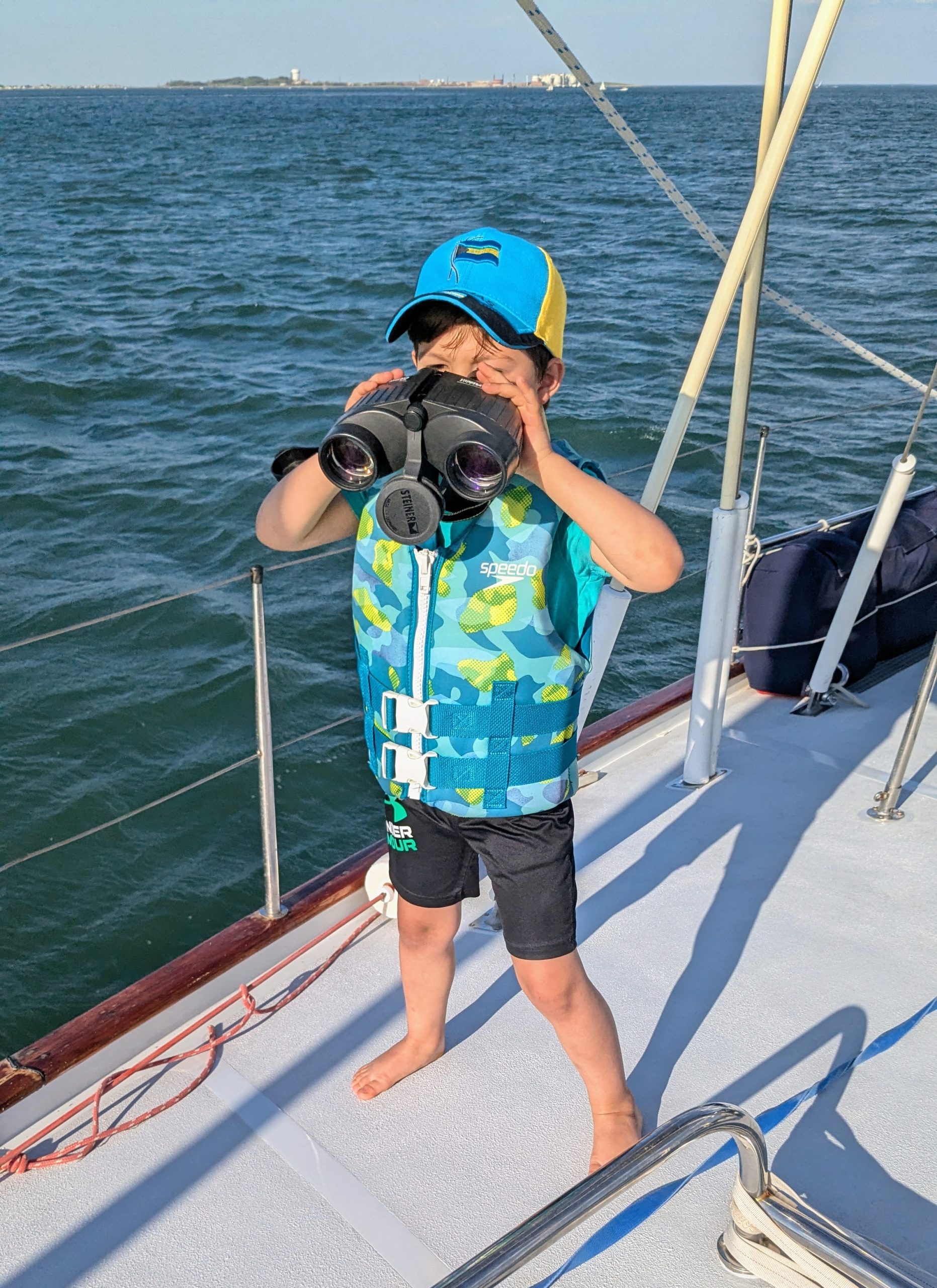
On Sunday we welcome Marius and Palak together with their friends Bart, Kathy and their three kids on board for a day sail. We had a gorgeous day with unseasonably high temperatures in the low 80s. What a treat!
Am Sonntag begrüßen wir Marius und Palak zusammen mit ihren Freunden Bart und Kathy sowie deren drei Kindern zu einem Tagesausflug an Bord. Wir hatten einen herrlichen Tag mit für diese Jahreszeit ungewöhnlich hohen Temperaturen bis zu 32 Grad. Ein schönes Erlebnis!


Schreibe einen Kommentar