
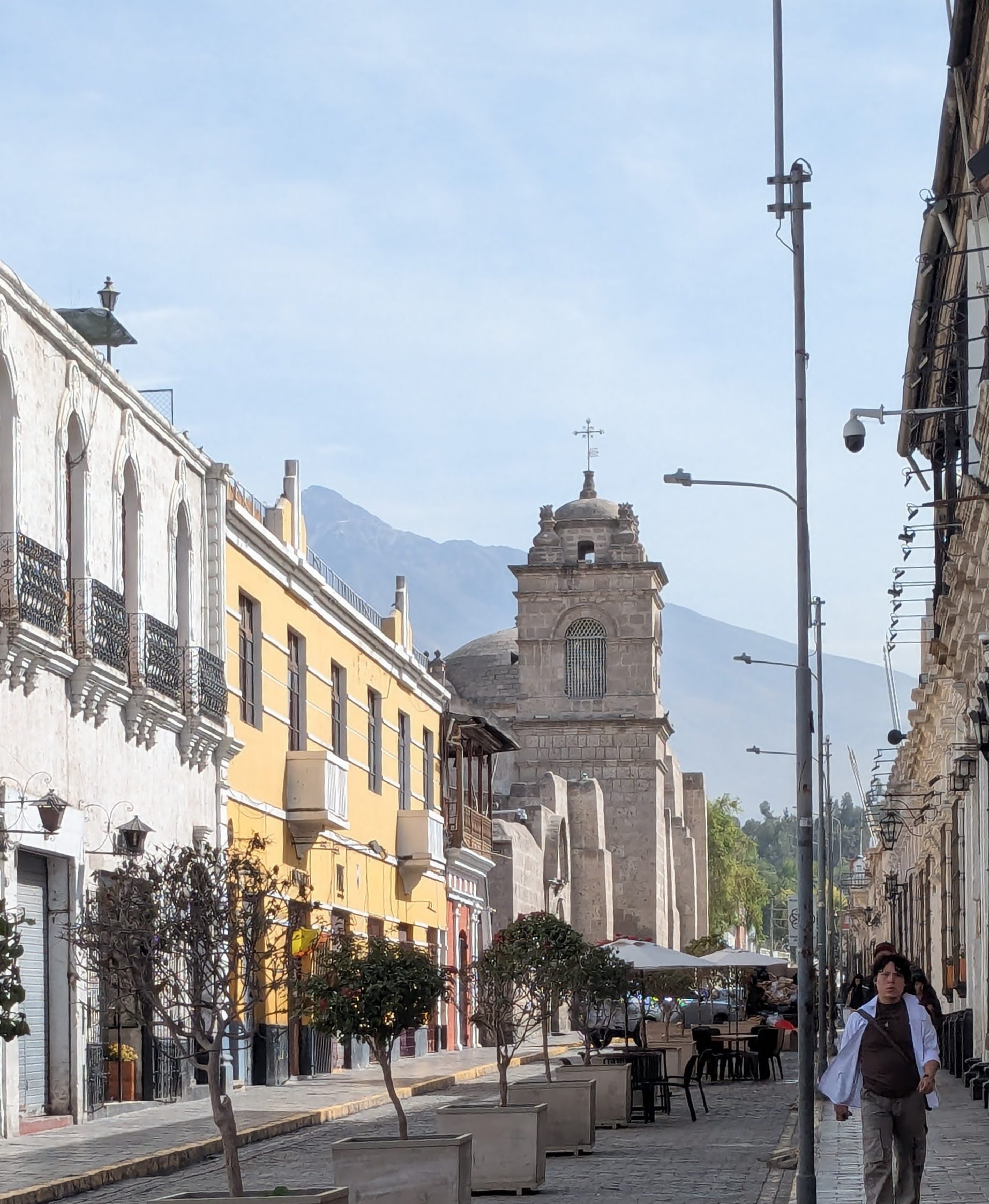
We leave the foggy, gray metropolis of Lima behind and head toward Arequipa. Located at an altitude of 7,660 ft (2,335 m), Arequipa is blessed with a pleasant climate and almost eternal sunshine (it has at least 300 sunny days per year). Daytime temperatures are usually around 65°F (18°C), and nights can dip down to 45°F (7°C).
Wir lassen die neblige, graue Metropole Lima hinter uns und machen uns auf den Weg nach Arequipa. Arequipa liegt auf einer Höhe von 2.335 m und ist mit einem angenehmen Klima und fast immerwährendem Sonnenschein gesegnet (es gibt mindestens 300 Sonnentage pro Jahr). Die Tagestemperaturen liegen in der Regel bei etwa 18 °C, nachts kann es bis auf 7 °C abkühlen.


After leaving the airport, we get our first view of the volcanoes surrounding Arequipa: Misti, Chachani, and Pichu Pichu.
Wenn wir den Flughafen verlassen, sehen wir zum ersten Mal die Vulkane, die Arequipa umgeben: Misti, Chachani und Pichu Pichu.


We hop in a taxi to get to the hotel, pick up some snacks at the bakery across the street, and then spend the afternoon and evening just wandering the cobblestone streets. We get our first impression of Arequipa and its colonial-era architecture, which earned the city its UNESCO World Heritage title. We wrap up the day with our first Pisco Sour, a traditional Peruvian cocktail. It’s made with pisco (a type of brandy made from distilling fermented grape juice), fresh lime juice, simple syrup, egg whites, ice, and Angostura bitters. It instantly becomes our new favorite cocktail!
Wir nehmen ein Taxi zum Hotel, kaufen ein paar Snacks in der Bäckerei gegenüber und verbringen den Nachmittag und Abend damit, durch die Kopfsteinpflasterstraßen zu schlendern. Wir gewinnen einen ersten Eindruck von Arequipa und seiner Architektur aus der Kolonialzeit, die der Stadt den Titel „UNESCO-Weltkulturerbe” eingebracht hat. Wir lassen den Tag mit unserem ersten Pisco Sour ausklingen, einem traditionellen peruanischen Cocktail. Er wird aus Pisco (einer Art Brandy, der aus fermentiertem Traubensaft destilliert wird), frischem Limettensaft, Zuckersirup, Eiweiß, Eis und Angostura Bitter zubereitet. Er wird sofort zu unserem neuen Lieblingscocktail!


The next morning, we get a gorgeous view of the volcanoes from our hotel. We head over to Plaza de Armas (yep, another one) to meet our guide for a city walking tour. He tells us a lot about the history and culture of Arequipa and leads us through streets we might have never found by ourselves. The city was founded in 1540 and has since become a patchwork of influences, including Indigenous foundations, Baroque splendor, Rococo and neoclassical designs, and contemporary buildings.
It’s interesting to note that there are daily earthquakes in Arequipa, mostly small tremors you can’t really feel, but they’re necessary to relieve pressure below. Otherwise, there could be an eruption of Misti that would destroy the entire town.
Am nächsten Morgen genießen wir von unserem Hotel aus einen herrlichen Blick auf die Vulkane. Wir laufen zur Plaza de Armas (ja, noch einer), um unseren Führer für einen Stadtrundgang zu treffen. Er erzählt uns viel über die Geschichte und Kultur von Arequipa und führt uns durch Straßen, die wir alleine nie gefunden hätten. Die Stadt wurde 1540 gegründet und ist seitdem zu einem Flickenteppich verschiedener Einflüsse geworden, darunter indigene Grundlagen, barocke Pracht, Rokoko- und neoklassizistische Designs und zeitgenössische Gebäude.
Interessant ist, dass es in Arequipa täglich Erdbeben gibt, meist kleine Beben, die man nicht wirklich spürt, die aber notwendig sind, um den Druck unter der Erde abzubauen. Andernfalls könnte es zu einem Ausbruch des Misti kommen, der die gesamte Stadt zerstören würde.


A look at the pictures makes it obvious why Arequipa is also called the “White City” or “Ciudad Blanca.” The main building material for Arequipa’s churches and mansions is sillar, a white volcanic stone that was quarried from nearby volcanoes like the Misti.
Ein Blick auf die Bilder macht deutlich, warum Arequipa auch als „Weiße Stadt“ oder „Ciudad Blanca“ bezeichnet wird. Das Hauptbaumaterial für die Kirchen und Herrenhäuser von Arequipa ist Sillar, ein weißer Vulkanstein, der aus nahe gelegenen Vulkanen wie dem Misti gewonnen wurde.


We stop by Mundo Alpaca to get a close-up look at the camelid fiber production process. We see how alpaca and vicuña fiber is sheared and then processed using a number of machines to make machine- and handmade garments.
Wir machen Halt bei Mundo Alpaca, um uns den Produktionsprozess der Kamelidenfasern aus nächster Nähe anzusehen. Wir sehen, wie Alpaka- und Vicuña-Fasern geschoren und anschließend mit verschiedenen Maschinen zu maschinell und handgefertigten Kleidungsstücken verarbeitet werden.


A definite highlight of Arequipa is the Monastery of Santa Catalina, one of Peru’s most striking colonial religious buildings and almost a citadel within the city. We go on a tour of this fascinating monastery for nuns, which was founded in 1579-1580, and we learn a lot about its history. Our guide tells us a bunch of interesting stuff, like that the second daughter of any rich Spanish family had to become a nun. When they got to the convent, they were cut off from the outside world. They weren’t even allowed to see their families. The families paid a lot of money, not just for their daughters’ dowries, but also for their living space, monthly expenses, and maids. Money was a big deal. The Mother Superior’s selection wasn’t based on her skills, but rather on her net worth. The Vatican made a radical change in 1870. They said that the nuns, including the Mother Superior, could no longer have their own private rooms with maids. They had to move into a dormitory with other nuns, share a kitchen, and do all the work themselves. I’m pretty sure this isn’t what they had in mind!
Ein absolutes Highlight von Arequipa ist das Kloster Santa Catalina, eines der beeindruckendsten religiösen Gebäude aus der Kolonialzeit in Peru und fast eine Zitadelle innerhalb der Stadt. Wir machen eine Führung durch dieses faszinierende Nonnenkloster, das zwischen 1579 und 1580 gegründet wurde, und erfahren viel über seine Geschichte. Unser Führer erzählt uns eine Menge interessanter Dinge, zum Beispiel, dass die zweite Tochter jeder reichen spanischen Familie Nonne werden musste. Als sie ins Kloster kamen, wurden sie von der Außenwelt abgeschnitten. Sie durften nicht einmal ihre Familien sehen. Die Familien zahlten viel Geld, nicht nur für die Mitgift ihrer Töchter, sondern auch für ihren Wohnraum, die monatlichen Ausgaben und die Dienstmädchen. Geld war eine große Sache. Die Auswahl der Oberin basierte nicht auf ihren Fähigkeiten, sondern auf ihrem Vermögen. Der Vatikan nahm 1870 eine radikale Änderung vor. Er erklärte, dass die Nonnen, einschließlich der Oberin, keine eigenen Zimmer mit Dienstmädchen mehr haben durften. Sie mussten in einen Schlafsaal mit anderen Nonnen umziehen, sich eine Küche teilen und alle Arbeiten selbst erledigen, eine ziemlich harte Umstellung. Ich bin mir ziemlich sicher, daß sie sich das nicht so vorgestellt haben!


With his descriptions of Arequipa’s culinary scene, our tour guide really made our mouths water. The rocoto relleno, a spicy stuffed pepper, is apparently the most famous dish here. So we look for one of Arequipa’s signature eateries, a picanteria, for lunch. The rocoto relleno is delicious, and the chicha morada, a traditional, non-alcoholic Peruvian drink made from boiled purple corn, pineapple, and spices like cinnamon and cloves, is pretty good too. Mmm, yum!
Unser Tourguide hat uns mit seinen Beschreibungen der kulinarischen Szene von Arequipa so richtig den Mund wässrig gemacht. Das Rocoto Relleno ist offenbar das berühmteste Gericht hier. Es handelt sich um eine scharfe gefüllte Paprika. Also suchen wir uns eines der typischen Restaurants von Arequipa, eine Picanteria, für unser Mittagessen. Der Rocoto Relleno ist köstlich, und die Chicha Morada, ein traditionelles, alkoholfreies peruanisches Getränk aus gekochtem violettem Mais, Ananas und Gewürzen wie Zimt und Nelken, schmeckt auch ziemlich gut. Mmm, lecker!


This afternoon, we’re going to go whitewater rafting on the Chili River! We meet the guide on Plaza de Armas, hop in the van and are being shuttled to the put-in spot where we change into wet suits and neoprene booties and put on a helmet and life-jacket. When Ikira, our guide, tells us to put the boat in the water, we know it’s crunch time. There’s no turning back! He puts us in the boat in order of weight to ensure it is balanced and won’t easily flip over. Our three teammates are also German and could be our sons. Then, he gives us a clear briefing and explains all the commands. Off we go!
Nachmittags machen wir eine Wildwasser-Rafting-Tour auf dem Chili River! Wir treffen unseren Guide auf der Plaza de Armas, steigen in den Van und werden zum Einstiegspunkt gefahren. Da ziehen wir unsere Neoprenanzüge und -stiefel an und legen Helme und Schwimmwesten an. Als Ikira, unser Guide, uns auffordert, das Boot zu Wasser zu lassen, wissen wir, dass es ernst wird. Es gibt kein Zurück mehr! Er verteilt das Gewicht der Leute im Boot gleichmäßig, damit es nicht so leicht umkippt. Unsere drei Teamkollegen sind auch Deutsche und könnten unsere Söhne sein. Dann gibt er uns eine klare Einweisung und erklärt alle Kommandos. Und los geht’s!


So, at one point, the boats stop, and anyone who wants to can climb up the cliff and jump into the river. Hans, of course, is not one to miss out on any fun, whereas I decide to thankfully decline. The water is so cold that I would never have gotten warm again, which is confirmed when one of our “kids spends the rest of the trip with chattering teeth.
Irgendwann halten die Boote an und alle, die Lust haben, können die Klippe hochklettern und in den Fluss springen. Natürlich lässt sich Hans diesen Spaß nicht entgehen, während ich dankend ablehne. Das Wasser ist so kalt, daß mir nicht mehr warm geworden wäre, was sich bestätigt, als eines unserer “Kinder” den Rest des Trips mit klappernden Zähnen verbringt.


It’s an incredible experience navigating the Class II–III rapids on this 5 km journey. It’s a real adventure for beginners and thrill-seekers alike. The area is gorgeous, the mountain views are absolutely breathtaking, and the trip is pretty relaxing at times. I totally get why whitewater rafting is often used for team-building exercises — you really have to work together as a team. Would we have made it down the river in one piece without our guide? Probably not. Ikira was in control the whole time, even when we turned around, floated backwards, and bumped into rocks. At least that’s what I wanted to believe.
Die 5 km lange Strecke mit ihren Stromschnellen der Klassen II–III ist echt der Hammer, ein Erlebnis für Anfänger und alle, die ein Abenteuer suchen. Die Gegend ist echt wunderschön, die Aussicht auf die Berge absolut atemberaubend und die Fahrt trotzdem teilweise ziemlich entspannend. Ich verstehe voll und ganz, warum Wildwasser-Rafting oft für Teambuilding-Maßnahmen genutzt wird – man muss wirklich als Team zusammenarbeiten. Hätten wir es ohne unseren Guide unbeschadet den Fluss hinunter geschafft? Wahrscheinlich nicht. Ikira hatte die ganze Zeit die Kontrolle, selbst als wir uns drehten, rückwärts trieben und gegen Felsen stießen. Zumindest wollte ich das so glauben.

After a day full of culture and excitement, we enjoy the evening by wandering through the beautiful colonial city, mingling with the locals, and enjoying some more street food. Then, we head to bed early because we know we have a full day ahead of us tomorrow.
Nach einem Tag voller Kultur und Abenteuer genießen wir den Abend, indem wir durch die wunderschöne Kolonialstadt schlendern, uns unter die Einheimischen mischen und noch mehr Street Food probieren. Dann gehen wir früh ins Bett, denn wir wissen, dass uns morgen ein voller Tag erwartet.


Leave a Reply