
While in Titusville, the two main items on our to-do list were to figure out what was wrong with our engine and possibly exchange our standing rigging.
Für unseren Aufenthalt in Titusville standen zwei Dinge ganz oben auf unserer To-do-Liste: herauszufinden, was mit unserem Motor nicht stimmte, und möglicherweise einen Teil der Takelage auszutauschen.

We contacted Clayton, a rigger who lives with his family on his boat in the marina. He stopped by to survey the situation. The result was that we needed a new forestay, a new triatic stay, new sail tracks, and new balls for our main sheet bearing block as well as the Spinnaker halyard exit block. We were surprised that the sail tracks needed to be replaced already because we installed them in 2019 to make the sails easier to lower. As with so many other items, the UV rays caused the material to deteriorate quickly. Clayton was super nice and not at all pushy. He allowed us to do whatever we could ourselves and pitched in when his expertise was needed. He gave most of the rigging a thumbs up, so the overall cost wasn’t too bad.
Wir kontaktierten Clayton, einen Rigger, der mit seiner Familie auf seinem Boot in der Marina lebt. Er kam vorbei, um sich die Sache anzusehen. Das Ergebnis war, dass wir ein neues Vorstag, ein neues Triatic-Stag, neue Segelschienen, einen neuen Spinnaker-Fall-Auslaufblock sowie neue Kugeln für unseren Großschot-Laufblock. Wir waren überrascht, dass die Segelschienen schon ausgetauscht werden mussten, da wir sie erst 2019 eingebaut hatten, um das Einholen der Segel zu erleichtern. Wie auch bei vielen anderen Teilen hatten die UV-Strahlen dazu geführt, dass das Material schnell verschlissen war. Clayton war super nett und überhaupt nicht aufdringlich. Er überließ uns alles, was wir selbst erledigen konnten, und sprang ein, wenn sein Fachwissen gefragt war. Er gab dem Großteil der Takelage ein „Daumen hoch“, sodass die Gesamtkosten überschaubar blieben.

Next to the marina was Boater’s Edge, a marine engine repair shop. The owner, Jeff, was very accommodating and stopped by to diagnose the engine problem. Diagnosis: exhaust, just as the mechanic in Cartagena had told us, although his “repair” didn’t last long. Jeff shared his knowledge freely with us and we removed the intake/exhaust manifold and replaced the gasket. After letting the engine run for at least a couple of hours, with increasing RPMs, it looked like that surprisingly did the trick.
Neben der Marina befand sich „Boater’s Edge“, eine Marine-Motorenwerkstatt. Der Besitzer, Jeff, war sehr zuvorkommend und kam vorbei, um das Motorproblem zu diagnostizieren. Diagnose: Auspuff, genau wie es uns der Mechaniker in Cartagena gesagt hatte, obwohl seine „Reparatur“ nicht lange gehalten hatte. Jeff teilte sein Wissen großzügig mit uns, und wir bauten den Ansaug-/Auspuffkrümmer aus und ersetzten die Dichtung. Nachdem wir den Motor einige Stunden lang laufen ließen und die Drehzahl dabei steigerten, schien das überraschenderweise den gewünschten Erfolg gebracht zu haben.
While Hans worked on the engine, I took some time off to visit Anja in Austin, Texas. I helped her with wedding dress shopping and we checked out their venue for the big day. I enjoyed spending time with Anja and Jonathan.
Während Hans am Motor arbeitete, nahm ich mir etwas Zeit, um Anja in Austin, Texas, zu besuchen. Ich half ihr bei der Suche nach einem Hochzeitskleid und wir schauten uns die Lokalität für den großen Tag an. Ich hatte viel Spaß dabei, Zeit mit Anja und Jonathan zu verbringen.


Shortly after my return, we left Titusville Marina on February 23 and dropped anchor in the lagoon, ready to leave early the next morning.
Kurz nach meiner Rückkehr verließen wir am 23. Februar die Titusville Marina und gingen in der Lagune vor Anker, bereit, am nächsten Morgen früh aufzubrechen.
Ten minutes into our trip, lots of white smoke billowed out of the exhaust. We had never experienced that before. Under these circumstances, we could definitely not continue; we had to turn around, re-anchor, and evaluate the situation.
Nach zehn Minuten Fahrt quoll dichter weißer Rauch aus dem Auspuff. So etwas hatten wir noch nie erlebt. Unter diesen Umständen konnten wir auf keinen Fall weiterfahren; wir mussten umkehren, erneut vor Anker gehen und die Lage evaluieren.

White smoke usually means that coolant is burning. We had noticed for a while that we had to refill the coolant, but we neither saw white smoke nor detected any leaks.
Weißer Rauch deutet in der Regel darauf hin, dass Kühlflüssigkeit verbrennt. Uns war schon seit einiger Zeit aufgefallen, dass wir Kühlflüssigkeit nachfüllen mussten, aber wir sahen weder weißen Rauch noch konnten wir eine undichte Stelle feststellen.
Over the next week, we searched online for possible solutions to our problem, checked a Westerbeke owners group for ideas, and consulted Jeff for assistance. The consensus was that the problem was most likely the heat exchanger. Jeff lent us a compression test tool, but we could not find any leaks. Another possibility is a warped cylinder head. Hans took the cylinder head off and brought it to a machine shop. After machining it to a level surface, we put the cylinder head back on, replaced the gaskets, turned on the engine, and hoped for the best. However, lots of white smoke was still coming out of the exhaust. By now, we can barely keep up with adding coolant to the system, which overheats quickly.
Im Laufe der nächsten Woche suchten wir online nach möglichen Lösungen für unser Problem, schauten in einer Westerbeke-Besitzergruppe nach Ideen und baten Jeff um Hilfe. Man war sich einig, dass das Problem höchstwahrscheinlich am Wärmetauscher lag. Jeff lieh uns ein Gerät zur Durchführens eines Kompressionstests, aber wir konnten keine Undichtigkeiten feststellen. Eine weitere Möglichkeit ist ein verzogener Zylinderkopf. Hans baute den Zylinderkopf ab und brachte ihn in eine Werkstatt. Nachdem er dort auf eine ebene Fläche bearbeitet worden war, setzten wir den Zylinderkopf wieder ein, tauschten die Dichtungen aus, starteten den Motor und hofften auf das Beste. Aus dem Auspuff kam jedoch immer noch viel weißer Rauch. Mittlerweile konnten wir kaum noch mit dem Nachfüllen von Kühlmittel nachkommen, da das System schnell überhitzte.


We contacted Titusville City Marina to see if they still had a slip available for us and if they could help us get MAKAAN back into the marina. At that point, we could barely run the engine without overheating right away, and we weren’t sure if we could make it into the marina (about 1 mile) without assistance. Thomas came out with the pump-out boat and towed us back to our old slip. The staff was waiting to take the lines and help us dock. We don’t know what we would have done without their help! Although we did not want these engine problems, they could not have happened in a better place. The entire staff at Titusville Marina was extremely helpful and went above and beyond to assist us.
Wir haben die Titusville City Marina kontaktiert, um zu fragen, ob sie noch einen Liegeplatz für uns frei hätten und ob sie uns helfen könnten, die MAKAAN wieder in die Marina zu bringen. Zu diesem Zeitpunkt konnten wir den Motor kaum laufen lassen, ohne dass er sofort überhitzte, und wir waren uns nicht sicher, ob wir es ohne Hilfe bis zum Yachthafen (etwa 1 Meile) schaffen würden. Thomas kam mit dem Abpumpboot und schleppte uns zurück zu unserem alten Liegeplatz. Das Team wartete bereits, um die Leinen zu übernehmen und uns beim Anlegen zu helfen. Keine Ahnung, was wir ohne ihre Hilfe gemacht hätten! Auch wenn wir diese Motorprobleme nicht gewollt hatten, hätten sie an keinem besseren Ort auftreten können. Das gesamte Personal der Titusville Marina war äußerst hilfsbereit und hat sich über das übliche Maß hinaus für uns eingesetzt, was wir sehr zu schätzen wussten.


So now what? We debated how much sense it would make to spend more time and money on the engine. Even if we repaired it, it’s almost 30 years old, and we don’t know what could fail next. Spare parts are also becoming increasingly difficult to find, especially in remote locations. The other option is a replacement, which is an expensive route to go but should give us peace of mind knowing we have a reliable engine for the foreseeable future.
Was nun? Wir haben darüber diskutiert, inwieweit es sinnvoll wäre, noch mehr Zeit und Geld in den Motor zu investieren. Selbst wenn wir ihn reparieren würden, ist er fast 30 Jahre alt, und wir wissen nicht, was als Nächstes kaputtgehen könnte. Auch Ersatzteile sind immer schwerer zu finden, besonders in abgelegenen Gegenden. Die andere Möglichkeit wäre ein Austausch – eine teure Lösung, die uns aber die Gewissheit geben würde, auf absehbare Zeit einen zuverlässigen Motor zu haben.
This is what we ended up doing. We contacted a Beta Marine engine dealer and ordered a Beta 60, with a delivery time of about six weeks. This and time for the installation will bring us to the end of April. That’ll still allow us five to six weeks to make it all the way up to St.John’s, New Foundland, to catch a good weather window at the end of June or beginning of July for our crossing to Greenland.
Letztendlich haben wir uns dafür entschieden. Wir haben einen Beta-Marine-Motorhändler kontaktiert und einen Beta 60 bestellt, dessen Lieferzeit etwa sechs Wochen beträgt. Zusammen mit der Zeit für den Einbau wären wir damit Ende April fertig. So blieben uns noch fünf bis sechs Wochen, um bis nach St. John’s auf Neufundland zu gelangen und dort Ende Juni oder Anfang Juli ein günstiges Wetterfenster für unsere Überfahrt nach Grönland zu erwischen.
While we waited, we removed the old engine through the cockpit sole with a chain hoist that we borrowed from Jeff at Boater’s Edge and an engine hoist leveler that we bought on Amazon.
Während wir warteten, bauten wir den alten Motor durch den Cockpitboden aus. Dazu verwendeten wir einen Kettenzug, den wir uns bei Boater’s Edge von Jeff ausgeliehen hatten, sowie ein Motorhebezeug (heisst das so?), das wir bei Amazon gekauft hatten.


We cleaned the engine room, which was covered in soot. It took several days, two bottles of degreaser, and plenty of dish soap to clean the walls, equipment, cables, and hoses.
Wir haben den Maschinenraum gereinigt, der voller Ruß war. Die Reinigung der Wände, Geräte, Kabel und Schläuche dauerte mehrere Tage und erforderte zwei Flaschen Entfetter sowie reichlich Spülmittel.


To fit the new engine, we adjusted the exhaust system by replacing the gooseneck and routing a new exhaust hose through the boat. The old hose was dry-rotted. We installed chafe gear on the exhaust hose and a new water lock. We also modified the water injector because the new one wouldn’t fit into the current configuration.
Um den neuen Motor einzubauen, haben wir die Abgasanlage angepasst. Dazu haben wir den Schwanenhals ausgetauscht und einen neuen Abgasschlauch durch das Boot verlegt. Der alte Schlauch war mittlerweile morsch. Wir haben den neuen Abgasschlauch mit einem Scheuerschutz versehen und einen neuen Wassersammler eingebaut. Zudem haben wir den Wassereinspritzdüse umgebaut, da das neue Modell nicht in die bestehende Konfiguration passte.
We removed some of the old engine wiring because it didn’t match, and we installed and wired a new engine panel in the cockpit. The water maker feed pump, including the hoses and cables, had to be relocated, as did the remote oil filter, including the new hoses. The fuel line system also had to be replaced, and a new fuel feed pump was installed. We also replaced the freshwater cooling hose — once you’re at it, you might as well do it right.
Wir haben einen Teil der alten Kabelverlegung des Motors entfernt, da sie nicht passte, und im Cockpit eine neue Motorbedienfeld eingebaut und verkabelt. Zudem mussten die Zufuhrpumpe des Wassermachers samt Schläuchen und Kabeln sowie der externe Ölfilter mitsamt der neuen Schläuche verlegt werden. Darüber hinaus musste das Kraftstoffleitungssystem ersetzt und eine neue Kraftstoffzufuhrpumpe eingebaut werden. Dann haben wir noch den Frischwasser-Kühlschlauch ausgetauscht – wenn man schon dabei ist, kann man es auch gleich richtig machen.
But that wasn’t all. We also installed the new air vent for the engine room blower, which we had already planned to do, and painted the expansion tank. We installed new hoses from the engine to the water heater to the expansion tank and back to the engine, as well as a new vent hose for the expansion tank.
Doch damit nicht genug. Wir haben auch die neue Entlüftung für das Gebläse im Maschinenraum eingebaut, was ohnehin schon geplant war, und den Expansionstank gestrichen. Zudem haben wir neue Schläuche vom Motor zum Warmwasserbereiter, zum Expansionstank und zurück zum Motor verlegt und einen neuen Entlüftungsschlauch für den Expansionstank installiert.


It all sounds simple enough, but in addition to the work, it takes a lot of time to figure out what bolts, screws, washers, nuts, hose clamps, and other fittings are needed, which ones we already have on board, which ones we need, and where to get them. Harbor Freight and Ace Hardware are about 2.5 miles away, and an hour passes quickly with a round-trip by bike, including shopping time.
Das mag einfach klingen, aber zusätzlich zur eigentlichen Arbeit kostet es viel Zeit, herauszufinden, welche Bolzen, Schrauben, Unterlegscheiben, Muttern, Schlauchschellen und sonstigen Befestigungsteile benötigt werden, welche wir bereits vorrätig haben, welche wir noch brauchen und wo wir sie besorgen können. Harbor Freight und Ace Hardware sind etwa 2,5 Meilen entfernt. Eine Stunde vergeht schnell, wenn man die Hin- und Rückfahrt mit dem Fahrrad sowie die Zeit für den Einkauf einrechnet.
Amidst all this engine work, we also found time to make dinghy chaps and covers for our jerry cans, dinghy tank, generator, and barbecue to shield them from harmful UV rays. For good measure, we also made a storage bag for the dinghy seat to hold life jackets, the dinghy anchor, and so on. We also replaced the vinyl of our full enclosure and restitched everything with UV-proof thread. It’s a great product, but it’s not fun to sew with because it tends to skip stitches and form loops.
Neben all diesen Arbeiten am Motor haben wir auch noch Schutzhüllen für unser Beiboot sowie Abdeckungen für unsere Kanister, den Beibootstank, den Generator und den Grill angefertigt, um sie vor schädlichen UV-Strahlen zu schützen. Und weil wir schon dabei waren, haben wir außerdem eine Aufbewahrungstasche für den Beibootsitz genäht, in der unter anderem der Beibootanker und die Rettungswesten Platz finden. Zudem haben wir das Vinyl unserer Vollverkleidung ausgetauscht und alles mit UV-beständigem Garn neu vernäht. Das Produkt ist toll, aber das Nähen damit macht keinen Spaß, da es dazu neigt, Stiche auszulassen und Schlaufen zu bilden.


Another complicated item on the preparation list was the engine mount adapters, which required a great deal of attention to detail. Unfortunately, we could not use the previous ones. To design the new adapters, we had to consider the angle and location of the existing propeller shaft in order to determine the correct height and angle of the engine after installation.
Ein weiterer kniffliger Punkt auf der Vorbereitungsliste waren die Motorlageradapter, deren Fertigung viel Detailgenauigkeit erforderte. Leider konnten wir die bisherigen nicht verwenden. Bei der Konstruktion der neuen Adapter mussten wir den Winkel und die Position der vorhandenen Propellerwelle berücksichtigen, um Höhe und Winkel des Motors nach dem Einbau richtig zu bestimmen.
Chris, who is both a liveaboard sailor and a machinist, helped us fabricate the new engine mount adapters out of solid aluminum blocks. This was difficult since the engine was not yet in the engine room. Hans made a template, and we thought we had done the math correctly, but Chris still had to alter the mounts a couple of times because of a slight miscalculation on our part.
Chris, der auf einem Segelboot lebt und von Beruf Maschinenschlosser ist, half uns dabei, die neuen Motorlageradapter aus massiven Aluminiumblöcken zu fertigen. Das war schwierig, da der Motor noch nicht im Maschinenraum stand. Zwar fertigte Hans eine Schablone an und wir dachten, wir hätten alles richtig berechnet, doch wegen eines kleinen Rechenfehlers unsererseits musste Chris die Halterungen noch ein paar Mal nacharbeiten.


During our six-week waiting period, we took two weeks off to visit Marius and Palak in Roanoke, Virginia, and help them renovate their house. They have already put in a tremendous amount of work and have now finished gutting the house. They are ready to start rebuilding. We can’t wait to see the finished product! The renovation will most likely be completed by the time we visit them next. We’re really curious to see what the final product will look like.
Während der sechswöchigen Wartezeit haben wir uns zwei Wochen Urlaub genommen, um Marius und Palak in Roanoke, Virginia, zu besuchen und ihnen bei der Renovierung ihres Hauses zu helfen. Sie haben bereits unglaublich viel Arbeit investiert und sind nun mit dem Rohbau fertig. Der Wiederaufbau kann beginnen. Wir können es kaum erwarten, das Endergebnis zu sehen! Die Renovierung wird höchstwahrscheinlich abgeschlossen sein, wenn wir sie das nächste Mal besuchen. Wir sind schon schwer neugierig, wie das Endprodukt aussehen wird.


As an added bonus, Kai and his girlfriend, Dirce, stopped by for the weekend, so we all took a break from the renovation work and enjoyed the great outdoors.
Ein zusätzliches Highlight war der Besuch von Kai und seiner Freundin Dirce übers Wochenende. Wir legten eine Pause von den Renovierungsarbeiten ein und genossen einen Ausflug in die Natur.


We also had the pleasure of spending time with our close friends, Lynda and Mark, who reside on the Gulf Coast of Florida. While we all still lived in Crystal Lake, we used to spend so much time together, on and off our boats, but both of our retirement plans put a lot of miles between us. Usually, our communication is limited to texting and video chats, so we were thankful that they didn’t mind driving four hours to Titusville.
Wir hatten auch das Vergnügen, Zeit mit unseren guten Freunden Lynda und Mark zu verbringen, die an der Golfküste Floridas leben. Als wir alle noch in Crystal Lake wohnten, verbrachten wir viel Zeit miteinander, sowohl auf unseren Booten als auch an Land, doch unsere jeweiligen Ruhestandspläne haben uns weit voneinander entfernt. Normalerweise bleiben wir via SMS und Videoanrufen in Kontakt, daher waren wir dankbar, dass es ihnen nichts ausmachte, vier Stunden nach Titusville zu fahren.

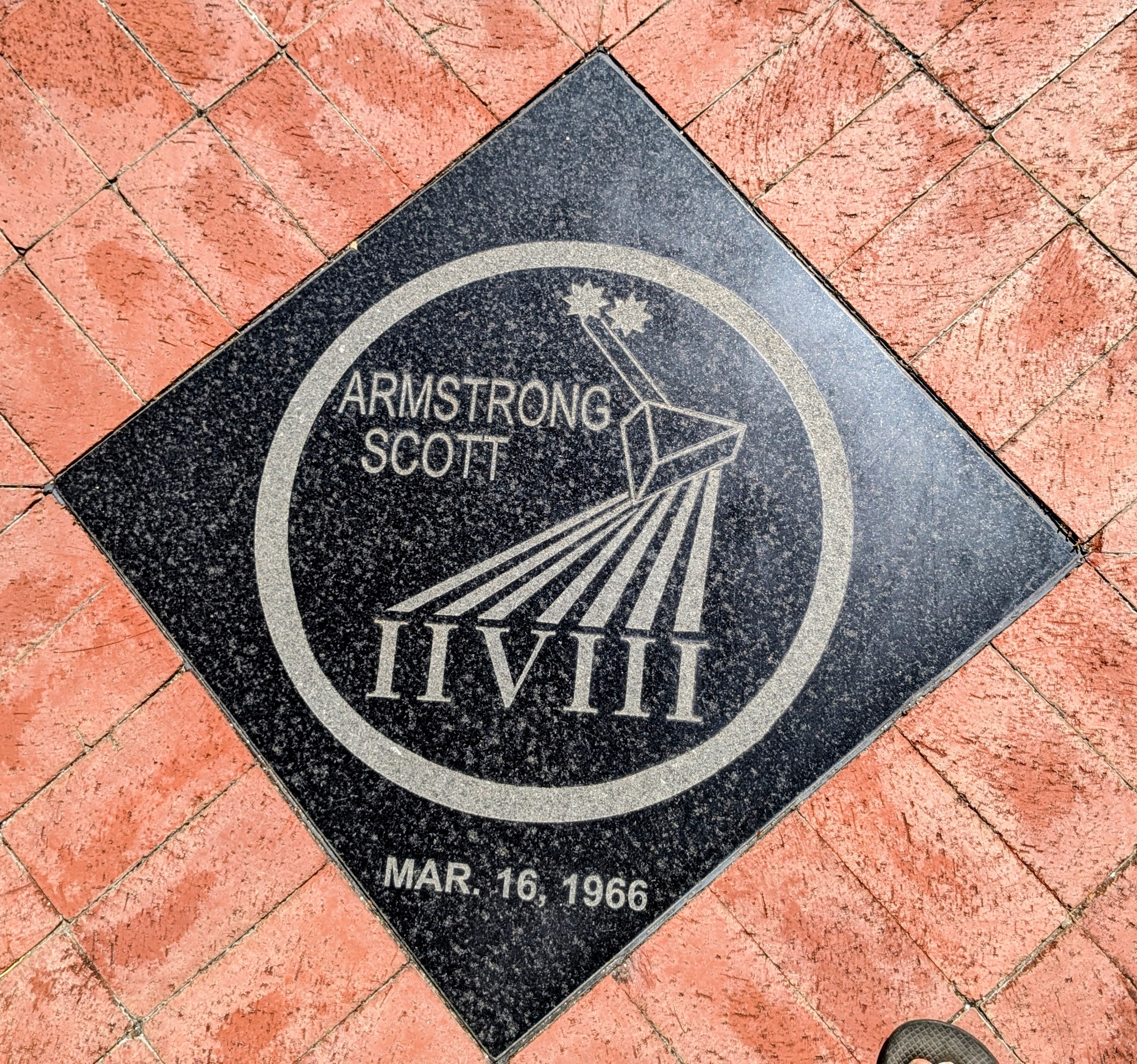
Founded in 1867, Titusville experienced tremendous growth after World War II due to the development of the U.S. space industry complex at Cape Canaveral. The first launch occurred there in 1950. We had the opportunity to witness multiple launches, primarily of rockets carrying satellites. On April 1, we learned that approximately 500,000 people had come to Titusville to watch the Artemis II launch, the first crewed NASA mission since Apollo 17 in 1972. Although we couldn’t see the liftoff from the bow of our boat, we still had a good view and avoided the crowds.
Die 1867 gegründete Stadt Titusville erlebte nach dem Zweiten Weltkrieg ein enormes Wachstum, als der US-Raumfahrtkomplex am Cape Canaveral aufgebaut wurde. Der erste Start fand dort im Jahr 1950 statt. Wir hatten die Gelegenheit, mehrere Starts mitzuerleben, vor allem von Raketen, die Satelliten transportierten. Uns wurde gesagt, daß am 1. April etwa 500.000 Menschen nach Titusville gekommen waren, um den Start von Artemis II zu verfolgen – der ersten bemannten NASA-Mission seit Apollo 17 im Jahr 1972. Obwohl wir den Start vom Bug unseres Bootes aus nicht sehen konnten, hatten wir dennoch eine gute Sicht und entgingen den Menschenmassen.


The day we had been waiting for and preparing for was finally here. On April 15, we took possession of our new Beta Marina 60. Unfortunately, the engine could not be unloaded directly at our marina in front of our dock; it had to be delivered to another marina down the road.
Der große Tag war endlich da. Am 15. April nahmen wir unsere neue Beta Marina 60 in Empfang. Leider konnte der Motor nicht direkt an unserem Liegeplatz in unserer Marina abgeladen werden, sondern er musste von einer anderen Marina weiter die Straße hinunter in Empfang genommen werden.
This raised the question: How would we transport a 600-pound engine from there to our boat? Since we had already picked up two dollies at Harbor Freight, we asked the forklift driver to place the crate containing the engine directly on them. Then, Hans drilled some screws through the crate’s wood and into the dollies to secure it. We began pushing the heavy load toward our dock. A friendly marina tenant offered his help, and who are we to decline?
Das warf die Frage auf: Wie sollten wir einen 600 Pfund schweren Motor zu unserem Boot transportieren? Wir hatten bereits zwei kleine Rollbretter bei Harbor Freight gekauft. und baten deshalb den Gabelstaplerfahrer, die Kiste mit dem Motor direkt darauf abzustellen. Dann bohrte Hans einige Schrauben durch das Holz der Kiste in die Rollbretter, um sie zu befestigen. Wir begannen, die schwere Last in Richtung unseres Stegs zu schieben. Ein freundlicher Dauergast der Marina bot uns seine Hilfe an, die wir gerne angenommen haben.


A couple days later, we connected the load leveler and chain hoist to the engine. With the help of two sailors from our dock, we slowly dropped the engine into the engine room. Removing the old engine block had been much easier, as Hans had taken off as many parts as possible. Obviously, we wanted to avoid doing that to the new one. Even with the leveler tilted to its maximum capacity, however, we could not fit the engine through the opening. Ultimately, we had to remove the alternator and a couple of other engine parts to make it fit. It took a lot of maneuvering to fit the engine through the barely big-enough opening in the cockpit sole and into the engine room.
Ein paar Tage später befestigten wir den Lastverteiler und den Kettenzug am Motor. Mit Hilfe von zwei Seglern aus unserem Hafen ließen wir den Motor langsam in den Maschinenraum hinab. Der Ausbau des alten Motorblocks war viel einfacher gewesen, da Hans bereits so viele Teile wie möglich abmontiert hatte. Das wollten wir beim neuen Motor natürlich vermeiden. Doch selbst mit dem Lastverteiler bis zum Anschlag geneigt, passte der Motor nicht durch die Öffnung. Letztendlich mussten wir die Lichtmaschine und einige andere Motorteile demontieren. Nach vielem Manövrieren bekamen wir den Motor schließlich durch die kleine Öffnung im Boden des Cockpits in den Maschinenraum.


All of our prior preparation paid off, and we connected the engine to all the components in only two days. With butterflies in our stomachs, we turned the key and started the engine for the first time. We didn’t put the engine in gear yet since the propeller shaft hadn’t been aligned. We breathed a sigh of relief when the engine started running smoothly, and we considered the installation a success so far.
Unsere ganze Vorbereitungsarbeit hat sich ausgezahlt: Wir haben den Motor in nur zwei Tagen an alle Komponenten angeschlossen. Mit einem Kribbeln im Bauch drehten wir den Schlüssel um und starteten den Motor zum ersten Mal. Wir legten jedoch keinen Gang ein, da die Propellerwelle noch nicht ausgerichtet war. Wir atmeten erleichtert auf, als der Motor ruhig zu laufen begann, und betrachteten den Einbau soweit mal als Erfolg.

Aligning the engine with the propeller shaft was the last step of the installation and critical. This ensures greater efficiency and a longer engine life, while also preventing problems related to coupling and bearing wear. Jeff provided instructions for the alignment process. However, since this was an important step, we hired Jeff to check our work and make corrections if necessary. We are proud to say that Jeff was satisfied with our work, and we were able to start the engine and put it in gear. Everything was running smoothly, so we went ahead with the sea trial, which we also completed successfully.
Die Ausrichtung des Motors auf die Propellerwelle war der letzte entscheidende Schritt der Installation. Dies gewährleistet einen höheren Wirkungsgrad und eine längere Lebensdauer des Motors und beugt zudem Problemen im Zusammenhang mit Kupplungs- und Lagerverschleiß vor. Jeff gab uns Anweisungen für den Ausrichtungsvorgang. Da es sich jedoch um einen wichtigen Schritt handelte, beauftragten wir ihn, unsere Arbeit zu überprüfen und gegebenenfalls Korrekturen vorzunehmen. Wir sind stolz darauf, sagen zu können, dass Jeff mit unserer Arbeit zufrieden war und wir den Motor starten und in den Gang legen konnten. Da alles reibungslos verlief, konnten wir die Probefahrt durchführen, die wir ebenfalls erfolgreich absolvierten.
On May 2nd, after a final Friday night barbecue and saying goodbye to all our new friends, we started our journey north for the second time.
Nach einem letzten Freitagrillabend und nachdem wir uns von all unseren neuen Freunden verabschiedet hatten, machten wir uns am 2. Mai zum zweiten Mal auf den Weg in Richtung Norden.


Leave a Reply