
It’s day two in the 10-million-strong city of Lima, and it’s just as grey as day one. At first, we thought this was just bad luck, but then we found out that this is the typical weather in Lima for 9 months of the year — humid, foggy and grey. Although Lima only gets 6.4 mm (0.3 in) of rainfall per year. I don’t think I could live here!
Es ist der zweite Tag in der 10-Millionen-Stadt Lima, und es ist genauso grau wie am ersten Tag. Zuerst dachten wir, das sei einfach Pech, aber dann fanden wir heraus, dass dies das typische Wetter in Lima für 9 Monate im Jahr ist – feucht, neblig und grau. Lima hat zwar nur 6,4 mm Niederschlag pro Jahr, aber hier wollte ich nicht leben!
Our first stop today is Huaca Pucclana, one of Lima’s two famous adobe pyramids from the Lima Culture (AD 200 to 700). Unlike the Egyptian pyramids, this solid structure has no holes or tunnels and consists of seven platforms. The platforms are arranged in tiers and are made of millions of sun-dried mud bricks. It took 200 years to build Huaca Pucclana, and the Wati and Yschma cultures used it before it was abandoned during the 1400s. They used the pyramid for rituals (human sacrifices), celebrations, and banquets (shark meat for the priests and leaders). So far, they found 82 tombs that have clothing, gold, and ceramics in them. These things were used to prepare the dead for the afterlife. The pyramid was discovered again in 1960, and the official excavation work began in 1981.
Unser erster Stopp heute ist die Huaca Pucclana, eine der beiden berühmten Lehmziegelpyramiden Limas aus der Lima-Kultur (200 bis 700 n. Chr.). Im Gegensatz zu den ägyptischen Pyramiden handelt es sich hierbei um eine massive Struktur ohne Löcher oder Tunnel, die aus sieben Plattformen besteht. Diese sind stufenförmig angelegt und aus Millionen von sonnengetrockneten Lehmziegeln gebaut. Der Bau der Huaca Pucclana dauerte 200 Jahre. Nach den Lima nutzten die Wari- und die Yschma-Kultur die Pyramide, bevor sie im 15. Jahrhundert aufgegeben wurde. Sie diente für Rituale (Menschenopfer), Feierlichkeiten und Bankette (Haifleisch für die Priester und Anführer). Bislang wurden 82 Gräber entdeckt, in denen Kleidung, Gold und Keramik gefunden wurden. Diese Gegenstände dienten dazu, die Toten für das Leben nach dem Tod vorzubereiten. Die Pyramide wurde 1960 wiederentdeckt und die offiziellen Ausgrabungsarbeiten begannen 1981.


After the tour ends, we walk for half an hour down to the scenic Malecón de Miraflores, a six-mile cliffside pedestrian walkway offering breathtaking ocean views. This stretch of boardwalks is lined with vendors, restaurants, and lovely parks, making it a pleasure to stroll through.
Nach Ende der Führung spazieren wir eine halbe Stunde lang hinunter zum Malecón de Miraflores. Diese sechs Meilen lange Fußgängerpromenade entlang der Steilküste bietet einen atemberaubenden Blick auf den Pazifik. Die Promenade ist gesäumt von Verkaufsständen, Restaurants und schönen Parks, ein echtes Vergnügen, hier entlangzuschlendern.


Parque del Amor (Love Park) is the most popular park on the entire Malecón, featuring the famous El Beso (The Kiss) statue by Peruvian artist Víctor Delfín. The statue depicts Delfín kissing his wife. The park also has Gaudi-style benches adorned with ceramic mosaics.
Der Parque del Amor (Liebespark) ist der bekannteste Park entlang des gesamten Malecón und besticht durch die berühmte Statue El Beso (Der Kuss) des peruanischen Künstlers Víctor Delfín. Die Statue zeigt Delfín, wie er seine Frau küsst. Im Park befinden sich zudem Bänke im Stil Gaudís, die mit schönen Keramikmosaiken verziert sind.


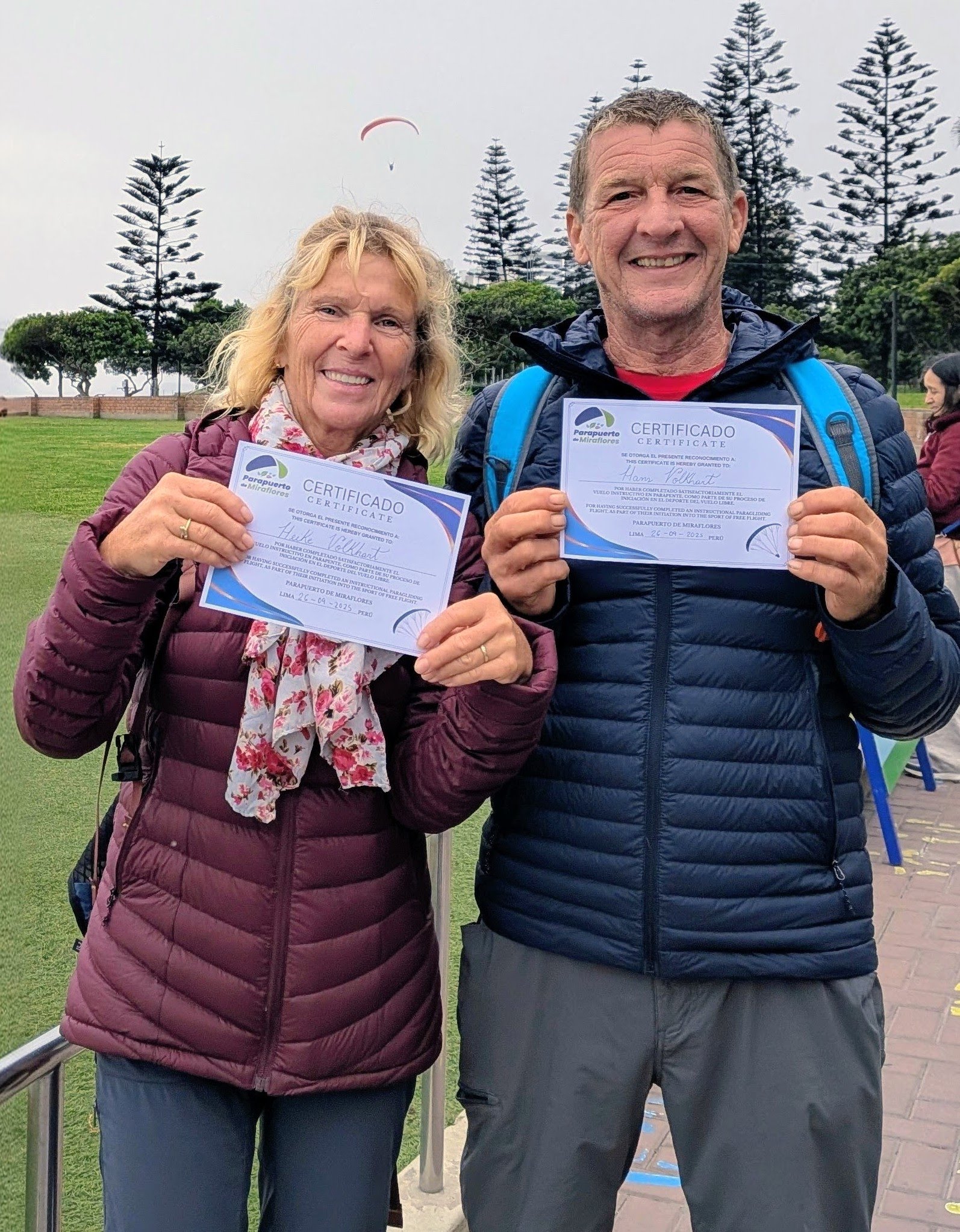
We admire the numerous parks until we reach a spot where we see paragliders lounging in the grass. They seem to be waiting for the perfect wind. But they’re not waiting for the perfect wind; they’re waiting for US. Hans gets a mischievous twinkle in his eye and asks, “Shall we do it?” It takes a little bit of convincing, but then we pay the fee and get strapped to our pilots. We’re really doing it!
Wir laufen durch die zahlreichen Parks, bis wir an eine Stelle kommen, an der wir Gleitschirmflieger im Gras liegen sehen. Sie scheinen auf den perfekten Wind zu warten. Aber nein, sie warten nicht auf den perfekten Wind, sie warten auf uns. Hans bekommt ein verschmitztes Funkeln in den Augen und fragt: „Na, sollen wir?“ Nach ein wenig Überzeugungsarbeit bezahlen wir die Gebühr und werden an unsere Piloten geschnallt. Wir machen es wirklich!
We start running and, right before reaching the cliffs, the wind snatches the canopy, lifting us effortlessly into the sky. What an amazing feeling! The initial heart-pounding rush gives way to an unbelievable serenity as we settle into our harnesses, suspended in a quiet, open space with just the sound of the wind in our ears.
Wir rennen los und kurz bevor wir die Klippen erreichen, erfasst der Wind den Schirm und hebt uns mühelos in die Luft. Was für ein faszinierendes Gefühl! Das anfängliche Herzklopfen weicht einer unglaublichen Gelassenheit. Wir machen es uns im Harness bequem und gleiten lautlos durch die Luft. Nur das Rauschen des Windes ist in unseren Ohren zu hören.


The 20 minutes go by too quickly, and it is time to prepare for landing. The landing is as smooth and gentle as the flight itself—a soft return to solid ground. The whole experience was simply breathtaking!
Die 20 Minuten vergehen viel zu schnell und schon ist es Zeit, sich auf die Landung vorzubereiten. Die Landung ist genauso weich und ruhig wie der Flug selbst – eine sanfte Rückkehr auf festen Boden. Das gesamte Erlebnis war einfach atemberaubend!


We hop on a bus to ride to the next neighborhood we want to visit. Turns out we picked the wrong bus, but the ride gives us a glimpse into the everyday commuter life of the locals. The bus is packed, and at various stops, vendors board and try to sell their goods. That’s definitely a new experience! We ask the passengers how to get to our destination, and a friendly lady gets off the bus with us. She directs us to the bus line that will take us where we originally wanted to go – the Barranco neighborhood.
Wir nehmen den Bus, um ins nächste Viertel zu fahren, das wir besuchen möchten. Blöderweise haben wir den falschen Bus erwischt, aber die Fahrt gibt uns einen Einblick in den Alltag der Einheimischen. Der Bus ist gestopft voll und an verschiedenen Haltestellen steigen Verkäufer zu, die versuchen, ihre Waren zu verkaufen. So etwas haben wir auch noch nicht erlebt. Wir fragen die Fahrgäste, wie wir zu unserem Ziel kommen. Eine freundliche Dame steigt mit uns aus dem Bus und lotst uns zu der Buslinie, die uns an unser ursprüngliches Ziel bringt, dem Stadtteil Barranco.


The Barranco neighborhood is celebrated for its bohemian charm. It is a vibrant, artistic neighborhood with a laid-back atmosphere. The area is brimming with colorful street art, galleries, trendy cafés, boutique clothing stores, and award-winning restaurants, all set against a backdrop of historical architecture and ocean views.
Der Stadtteil Barranco ist für seinen Bohème-Charme bekannt ist. Es ist ein lebhaftes, künstlerisches Viertel mit einer entspannten Atmosphäre. Die Gegend ist voller farbenfroher Straßenkunst, Galerien, trendiger Cafés, Boutiquen und preisgekrönter Restaurants. All das spielt sich vor dem Hintergrund historischer Architektur ab und bietet einen Blick auf das Meer.


The La Ermita de Barranco church was closed after an earthquake damaged its adobe structure in 1940. Despite several restoration attempts, La Ermita has remained closed to the public. By the time the site was listed on the 2016 World Monuments Watch, the roof had almost completely collapsed.
Die Kirche La Ermita de Barranco musste nach einem Erdbeben im Jahr 1940 geschlossen werden, da ihre Lehmziegelkonstruktion beschädigt worden war. Trotz mehrerer Restaurierungsversuche blieb sie für die Öffentlichkeit geschlossen. Als die Stätte im Jahr 2016 in die Liste der World Monuments Watch aufgenommen wurde, war das Dach bereits fast vollständig eingestürzt.


Of course, two days in Lima is just enough time to see the city’s main highlights, such as the historic center and the coastal districts of Miraflores and Barranco. There’s no doubt that the city, with its unique blend of culture, cuisine, and charm, could merit a longer stay. However, our time in Lima is coming to an end, and the next morning, we’re heading to Arequipa, Peru’s second most populous city.
Zwei Tage in Lima reichen natürlich gerade einmal aus, um die wichtigsten Sehenswürdigkeiten wie das historische Zentrum und die Küstenviertel Miraflores und Barranco zu besichtigen. Die Stadt mit ihrer einzigartigen Mischung aus Kultur, Küche und Charme würde zweifellos einen längeren Aufenthalt verdienen. Unsere Zeit in Lima neigt sich allerdings dem Ende zu und am nächsten Morgen machen wir uns auf den Weg nach Arequipa, der zweitgrößten Stadt Perus.


Leave a Reply